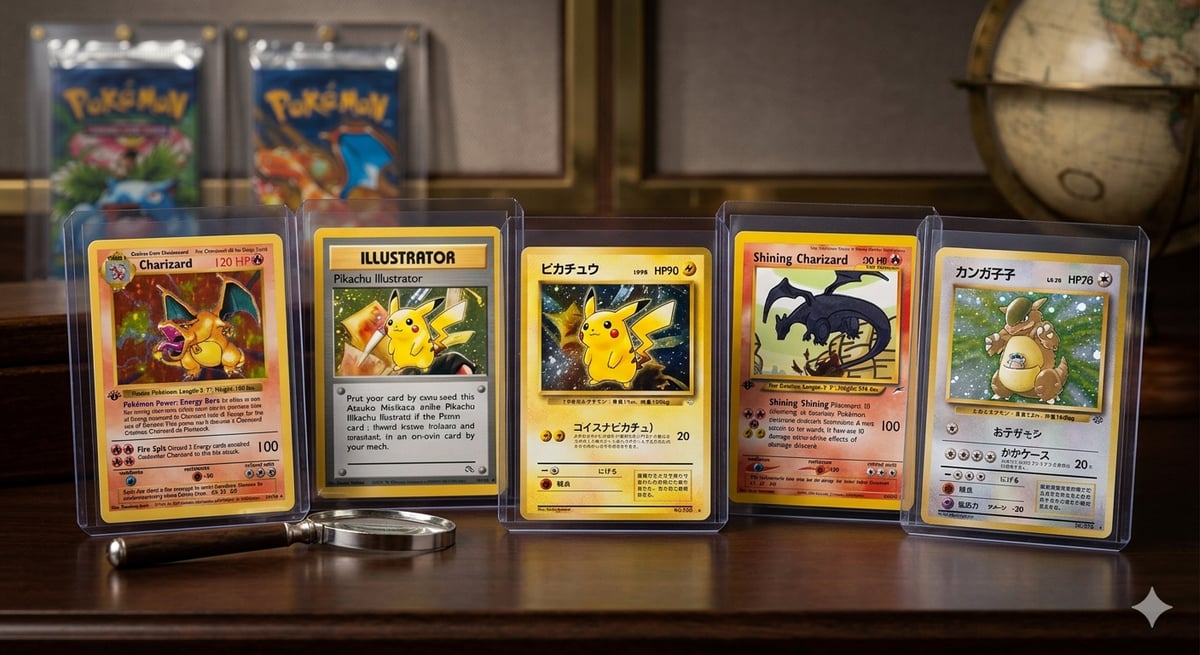
There's something different about Pokémon cards at the top of the market. They stopped being games a long time ago. The cards on this list have sold for more than Ferraris, more than Basquiat paintings, more than most houses in most cities. And each one has a story that explains — once you hear it — exactly why.
Here are the ten most valuable Pokémon cards, ranked by documented sale prices, with the context that makes each number make sense.
1. Pikachu Illustrator — The Only Card That Says "Illustrator" Instead of "Trainer"
Peak sale: $5,275,000 (€4.905.750) (Logan Paul, 2022)
Before Pokémon was a card game, it was a manga in CoroCoro Comic, the Japanese children's magazine that would eventually become the franchise's spiritual home. In 1997 — a full year before the TCG launched internationally — CoroCoro ran an illustration contest. Kids submitted their own Pokémon artwork. The best entries were published in the magazine.
The prize for winning wasn't cash. It was a card. Not a game card, not a tournament prize — a card specifically designed as an art award. It reads "Illustrator" in the corner where every other training card in the world says "Trainer." That misprint-looking typography is intentional, and it's why this card exists in a category of exactly one.
Approximately 39 copies were distributed. Of those, only around 10 have been professionally graded, and fewer than a handful have ever come to market. The $5.275 million (€4.905.750) Logan Paul paid for a PSA 10 isn't just the highest price ever paid for a Pokémon card — it's the highest price ever paid for any trading card, in any franchise, in any format.
2. 1999 Base Set Shadowless Charizard PSA 10 — The Card That Started Everything
Peak sale: €390.600 (2022)
The story of the shadowless Charizard begins with a printing error that Nintendo decided to keep.
The original 1999 Base Set cards were printed with a slight drop shadow behind the card artwork — a small design flourish that gave the images a bit of depth. Shortly after initial production, Nintendo changed the design specification and removed that shadow. The first print run, already in distribution, became the "Shadowless" edition — identifiable by the clean, shadow-free artwork border and the slightly bolder font on the HP counter.
Shadowless Charizard PSA 10s are genuinely rare because the initial print run was modest and because Gem Mint condition WOTC cards from 1999 require extraordinary luck and extraordinary storage. The card has been opened from packs by kids who bent it, played with it, rubber-banded it. Every PSA 10 that exists is a survivor.
At €390.600, it remains the most culturally recognized Pokémon card in the world — the one non-collectors have actually heard of.
3. 1998 Topsun Charizard Blue Back — A Pokémon Card That Predates the TCG
Peak sale: €458.704 (2021)
Most collectors don't know this card exists. It predates the Wizards of the Coast TCG by nearly two years.
In 1997, a Japanese candy company called Topsun produced a series of Pokémon cards inserted into bubblegum packs — not as a trading card game, but as collectible novelties. These cards have no HP values, no attacks, no game mechanics at all. They're essentially illustrated stickers in card form.
Two versions were produced: a green-back and a blue-back. The blue-back cards came only in special packs with an offer to exchange a specific number of wrappers for a curated selection. This made the blue-backs rarer from day one.
The Topsun Charizard Blue Back that sold for $493,230 (€458.704) was raw — ungraded. The new owner submitted it to PSA and received a PSA 8. Its value comes from being a legitimate piece of Pokémon history that existed before most people knew what Pokémon was.
4. 1st Edition Shadowless Charizard PSA 9 — Investment Foundation
Current market: €27.900 – 47,000
If the PSA 10 is the trophy, the PSA 9 is the investment.
The 1st Edition stamp — a small circular badge on the left side of the card, below the illustration — was applied to the very first production run of the Base Set in the United States. Once that print run sold out, subsequent printings carried no stamp. The window for 1st Edition production was approximately four months.
A PSA 9 1st Edition Shadowless Charizard means you have a card from that specific four-month window, in Near-Mint condition, with documented and authenticated provenance. The price range reflects genuine market liquidity — thousands of serious collectors actively want one, and supply is fixed.
5. Tropical Mega Battle Trophy Card — Only 12 Ever Made
Last known sale: €60.543 (2020)
In 1999, Nintendo ran a Pokémon TCG tournament series across several locations — but the Hawaii location, called the Tropical Mega Battle, was special. It was invitation-only. To participate, you had to win a regional qualifier in your country and receive an official written invitation from Nintendo.
Approximately 50 trainers attended from countries across Asia and North America. Each finalist received a trophy card featuring a Meowth playing cards on a beach — an illustration that exists nowhere else in the TCG. Of those trophy cards, only 12 are believed to be in collectors' hands today.
The rarity here isn't about a print run of thousands being reduced to hundreds. It's about a production run of 12 to begin with.
6. 1st Edition Shadowless Blastoise PSA 10 — The Underrated Starter
Peak sale: €41.943 (2021)
Blastoise is chronically underrated by casual collectors who never got past Charizard. But among serious investors, a PSA 10 1st Edition Shadowless Blastoise is one of the most desirable position cards in the hobby.
The reason is simple math: the PSA population report for Blastoise PSA 10 Shadowless 1st Edition is extremely thin. Finding a Charizard in Gem Mint is a one-in-several-thousand proposition. Finding a Blastoise is harder, because the card received less attention in 1999 — which means fewer people preserved it carefully.
7. 1st Edition Shadowless Venusaur PSA 10 — The Completionist's Challenge
Peak sale: €51.150 (2021)
The rarest PSA 10 among the three original starters. Venusaur was always the "third choice" in the schoolyard — a dynamic that paradoxically helps its investment case now. Fewer were treasured, fewer were preserved, and the PSA population in Gem Mint is correspondingly thinner than even Blastoise.
For collectors building a complete 1st Edition Shadowless starter set in PSA 10 — a project that commands ultimate respect in the hobby — Venusaur is the final, hardest piece.
8. Shadowless Mewtwo PSA 10 — Philosophical Weight in Card Form
Current market: €7.440 – 14,000
Mewtwo's narrative weight in the original Pokémon lore is unmatched. The first Pokémon movie built its entire premise around his existence — a genetically engineered being questioning the ethics of his own creation. That cultural resonance translates directly to collector demand.
The Shadowless Mewtwo PSA 10 commands strong premiums for what is ostensibly a non-1st-Edition card because of two factors: pop report scarcity in Gem Mint, and the character's enduring iconic status. Mewtwo's market has proven more resistant to downturns than many comparable cards.
9. Neo Genesis 1st Edition Lugia PSA 10 — The Post-WOTC Flagship
Peak sale: €134.199 (2021)
Released in 2000 as part of the Neo Genesis expansion, Lugia was the face of Pokémon Gold and the most visually dramatic card in the set. The artwork — Lugia ascending from dark water, illuminated from below — was genuinely cinematic for its time.
The 1st Edition run of Neo Genesis is significantly smaller than the Base Set first edition because by 2000, the initial Pokémon craze had cooled slightly and print runs were adjusted accordingly. That makes Lugia 1st Edition PSA 10s rarer than many Base Set PSA 10s.
At €134.199, this card proved that serious money extends well beyond the original 151 Pokémon.
10. 2006 World Championship Tropical Wind — A Tournament Artifact
Last known sale: $65,500 (€60.915) (Heritage Auctions)
The World Championship series has produced some of the most compelling trophy cards in the TCG's history. The 2006 Tropical Wind — featuring a Mew on a beach scene — was distributed to finalists at the Pokémon World Championships in Hawaii.
Like all tournament trophy cards, these were never available for retail purchase at any price. You had to earn them. That gatekeeping creates a provenance story that no reprint or reproduction can replicate — and it's that story that drives prices at auction.
What These Cards Have in Common
Looking across this list, patterns emerge that inform serious collecting decisions:
Fixed, verifiable supply. Every card here has a population that is finite, documented, and declining as copies are lost or damaged over time. The PSA population reports provide real data on exactly how many high-grade copies exist.
Cultural narrative. The Illustrator card's contest history, the Tropical Mega Battle's invitation-only structure, the Topsun cards' pre-TCG existence — each story is specific, unique, and irreplaceable. Reprints don't share the story.
Condition as the real scarcity. For most cards here, the raw card is relatively findable. The Gem Mint, authenticated version of that card is what's genuinely rare.
How to Think About These Cards as a Collector
If you're building a collection with an eye toward value, these cards tell you the playbook: focus on documented scarcity, established grading provenance, and cultural significance that transcends the original game.
For practical entry points, we recommend starting with our Beginner's Guide to Pokémon Card Collecting before making any significant purchase — and always verify authenticity before buying vintage (see our guide to spotting fake cards). Digital portfolio tools can help you track these factors and monitor market movements for the cards in your collection.