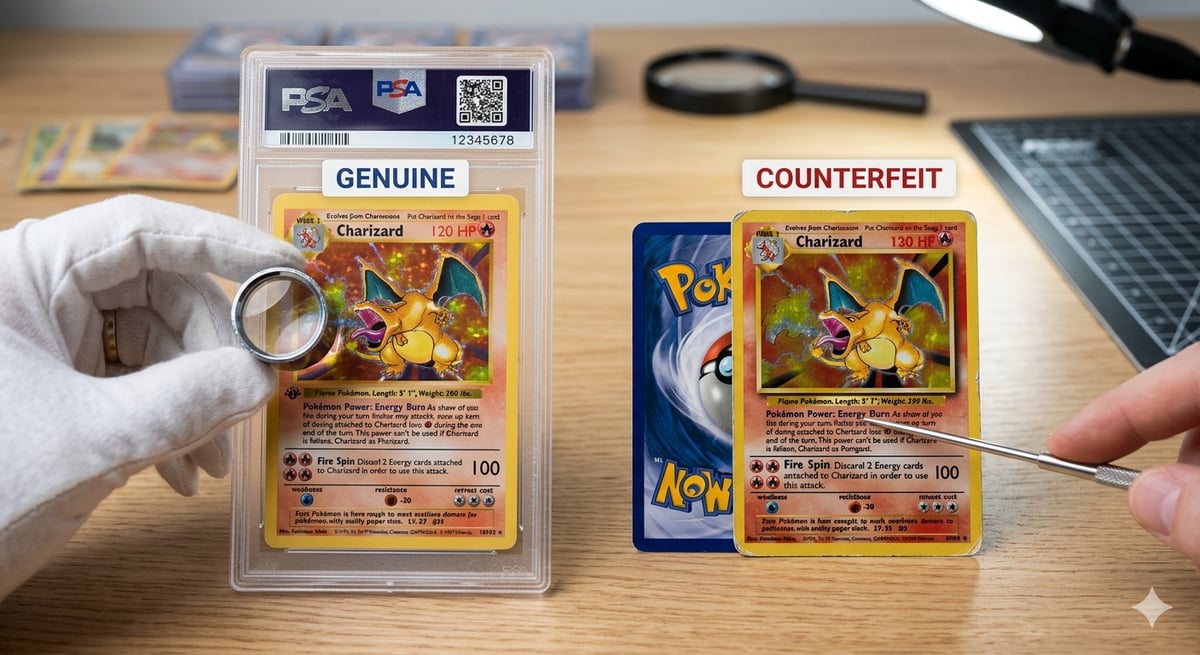
You found a listing on eBay or TCGPlayer that seems almost too good to be true. A 1st Edition Charizard at a fraction of market price. Or maybe you bought directly from someone — you thought it was safe — and then the package arrived, and the cardboard felt wrong somehow.
Fake Pokémon cards have become dramatically more sophisticated in recent years. A decade ago you could spot a counterfeit from across the room; today, high-quality reproductions fool even experienced collectors. This guide gives you a system — not guesswork, not gut feeling, but concrete checkpoints — so you can assess any card yourself.
Why Fake Cards Are a Growing Problem
The economics are straightforward: a fake 1st Edition Charizard PSA 10 costs maybe a dollar to print. On the market, a real one could be worth €279.000+. Even a buyer who "only" pays €465 thinking they found a deal suffers enormous harm.
Counterfeiters are investing in better printing technology and in more professional fake PSA slabs. Yes — fake slabs. It's no longer enough to simply see a slab.
The good news: real cards have physical properties that are consistent and very hard to replicate. If you know what to look for, you make yourself a difficult target.
The System: Ten Authentication Markers
Work through these in order. The first few are fastest; the later ones take a bit more time but are decisive for high-value cards.
1. The Paper Stock Test (Most Important First)
Real Pokémon cards have a unique three-layer structure: a black middle layer sandwiched between two white outer layers. This black layer is a security feature that counterfeiters struggle to replicate exactly.
If you gently flex a card at one corner (with the owner's permission or on a test card), you can sometimes see the layer structure through the curve. More importantly, a real card has a very particular stiffness and a characteristic "snap-back" feel. A card that's too thin, too thick, or too flimsy is a red flag.
Tool: Digital calipers (€9 – 14). Real cards measure 0.76–0.82 mm. Notably outside that range is suspect.
2. The Holofoil Examination
For holo cards, the holographic pattern is one of the most telling differences between real and fake.
Rotate the card under different angles of light. A real card's holo has a smooth, flowing pattern — the characteristic "diamond" pattern of early WOTC-era cards, or the layered designs of later sets. Fake holos often look grainy, too uniformly shiny, or lack depth entirely: the image looks flat, almost printed-on rather than embedded.
Especially important: The 1st Edition Charizard and other WOTC holos have a very specific pattern. Study real cards intensely (from trusted sources) before buying expensive vintage.
3. Text Clarity
Hold the card under a strong magnifying glass (8–10x). On a real card, every text element — name, HP, attack descriptions, set symbol — is printed with crystalline sharpness. Letters have clean, defined edges.
On fakes under magnification you'll frequently see: blurry letters, ink dots scattered around the characters (halftone errors), or a slight grey cast in areas that should be white.
Tool: Jeweler's loupe 10x (€7 – 11) — essential and small enough for any pocket.
4. Color Saturation and Print Quality
Real cards have consistent, rich color reproduction. Hold a suspect card next to a known real one (if possible) and compare directly.
Common fake characteristics: artwork that looks too pale or washed out; colors that are oversaturated or too dark; a slightly yellow or blue cast in the white text area.
5. Border and Edge Quality
Examine the card edges under your loupe. Real WOTC cards have firm, clean edges with no visible layers or fraying. The white border separates clearly and crisply from the artwork.
Fakes often show: ragged or fibrous edges; visible paper layers at the card edge; or ink bleed where colors drift slightly into the margins.
6. Card Dimensions
Real Pokémon cards are a standard 2.5 × 3.5 inches (63 × 88 mm). Fakers using cheap print stock sometimes deviate slightly from this.
Tool: A ruler or calipers. Even a couple of tenths of a millimeter off can be suspicious — always measure at multiple points, since real cards have very consistent dimensions.
7. The Set Symbol
Every Pokémon set has a unique symbol. Look up a reference for the correct symbol for the set in question and compare precisely — shape, size, and placement.
Especially for 1st Edition cards (the "1st Edition" stamp on the left side below the illustration): this stamp has very specific typography and sizing. Faking this stamp to upgrade ordinary cards into more valuable ones is one of the most common methods.
8. The Card Back
The back of a Pokémon card shows the round Poké Ball logo with its characteristic blue and the text "Pokémon" below. The blue on real cards has a very specific depth and saturation.
Fakes frequently show: a blue that's too light or too saturated; slightly altered Poké Ball proportions; ink halos around white areas.
Practical tip: Print a reference back from a trusted source (like the official Pokémon website) and use it as a direct comparison.
9. The Cross-Section Test (For High-Value Cards)
For an expensive card, it's worth gently pressing a fingernail against an edge and feeling the layer structure. You should feel three clear layers: two firm outer layers and a slightly softer middle layer.
Important: Only do this on cards you already own or where the seller explicitly permits it. For material already graded in a PSA slab, this isn't possible — and that's where PSA verification takes over.
10. PSA Slab Verification
When a card is sold in a PSA slab, always verify the authenticity of the slab itself. On the back of every PSA slab is a certification number. Go to psacard.com → Certification Lookup and enter that number.
The result shows you: card, set, grade, and whether the cert is active and unaltered. If the number comes back not found, either the slab is fake or the number has been tampered with.
Common fakery: Fake slabs sometimes use real certification numbers from lower-value cards. Make sure the card shown on psacard.com matches what you're actually holding.
Red Flags When Buying
Some patterns are near-universal warning signs regardless of how good the rest looks:
Price significantly below market — If a 1st Edition Charizard PSA 9 is listed for €4.650 when market is €27.900+, something is wrong. Either the card is fake, the slab is fake, or the situation is otherwise suspect.
Seller won't send additional photos — A legitimate seller sends close-up photos from every angle without hesitation.
Cards from unverified Asian marketplaces — AliExpress, Temu, and similar platforms are documented sources of high-quality counterfeits. Amazon's third-party marketplace has also had known fake listings.
The "grandma's attic" story — The classic narrative that cards came from a relative's storage sounds authentic, but it's a frequently used story to bypass scrutiny.
Excessive packaging for a single card — Counterfeiters sometimes wrap cards in many extra layers to delay direct inspection and distract the buyer from checking immediately on arrival.
Grading Services: Which Are Safest?
| Service | Strength | Weakness | Best Use |
|---|---|---|---|
| PSA | Highest market premium, deepest buyer base | Long turnaround times | High-value vintage |
| BGS (Beckett) | Detailed sub-grades, Pristine 10 highly trusted | Lower secondary market liquidity than PSA | Ultra-premium |
| CGC | Faster, cheaper, growing acceptance | Not yet PSA-equivalent | Modern or budget vintage |
Decision Tree: Should You Buy This Card?
Use this flow when evaluating any vintage card purchase:
Is the price at or above market rate?
  YES → Continue checking
  NO (significantly below) → High suspicion; get authentication first

Does the seller have strong feedback specifically for Pokémon transactions?
  YES → Continue checking
  NO → Request additional photos; consider walking away

Does the card pass the paper/thickness test?
  YES → Continue to holo/text checks
  NO → Do not buy

Does the holo pattern match documented references?
  YES → Continue to text/border checks
  NO → Almost certainly fake

Does the PSA cert number verify on psacard.com?
  YES, matches → Safe to proceed
  NO → Do not buy under any circumstances
Your 4-Week Skill-Building Plan
Week 1 – Tool acquisition and calibration. Get a 10x jeweler's loupe (€7 – 11) and digital calipers (€9 – 14). Source 3–5 real cards from trusted channels (e.g. directly from TCGPlayer verified sellers). Examine them thoroughly with your new tools. Learn what authentic looks and feels like before you learn what fake looks like.
Week 2 – Study documented fakes. Reddit's r/PokemonTCG has regular "Fake or Real" threads with high-quality photos. Browse through them. The differences experts point out will start imprinting into your visual memory.
Week 3 – Practice on cheap cards. Buy 5–10 Common cards from the WOTC era for €0,47 – 2 each on TCGPlayer or eBay. Run all ten checkpoints methodically. These cards are cheap enough that mistakes don't hurt, but representative enough to sharpen your authentication instincts.
Week 4 – Stress test. Deliberately find mixed listings (some suspect, some clean) on eBay and decide before buying whether you'd have ordered. Review your calls afterward with community feedback.
Once authenticated, recording your cards in a digital portfolio helps maintain provenance records and track their value over time.
Read Next
- The 10 Most Valuable Pokémon Cards in 2026 — Understand what fakers most commonly try to replicate
- Beginner's Guide to Pokémon Card Collecting — The foundations every new collector needs