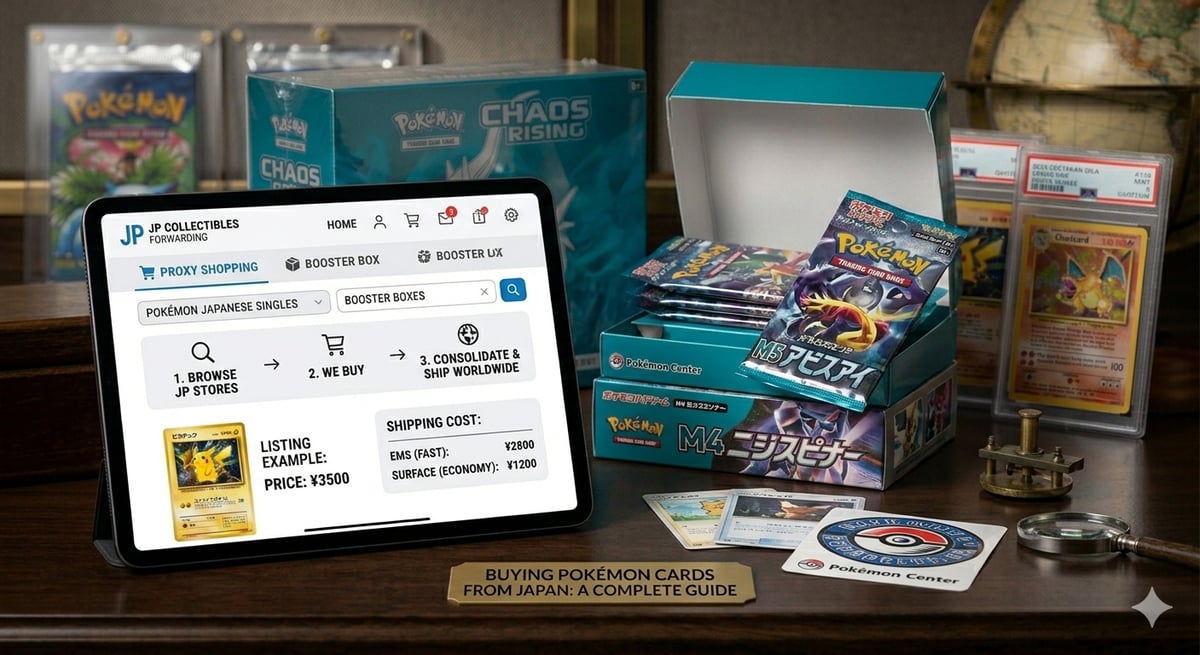
Japanese Pokemon cards are not a side market. They are the primary market that drives the global collector economy.
Sets launch in Japan 2-3 months before English releases. Exclusive promos never see international print. Card quality is consistently higher - Japanese printing tolerances are tighter, centering is better, and foil treatments are more refined. And for certain cards, Japanese text creates a distinct aesthetic that collectors specifically seek out.
In 2026, with the Mega Evolution era in full swing, the gap between Japanese and English markets matters more than ever. The Abyss Eye set (M5) launched in Japan on May 22 - English collectors won't see it until August at the earliest. Storm Emeralda (M6) arrives in Japan July 31. And the 30th Celebration in September marks the first-ever simultaneous worldwide Pokemon TCG release.
If you want the best cards first, you buy from Japan.
This guide covers exactly how to do that - which services to use, what fees to expect, how 2026 tariffs change the math, and which Japanese products are worth importing right now.
Why Japanese Cards
Three structural advantages make Japanese cards the better buy in most cases:
Timing. Japanese sets release 8-12 weeks ahead of English. If you're tracking competitive meta shifts or want to front-run price appreciation, buying Japanese gives you a two-month information advantage. Mega Evolution cards from Chaos Rising were available in Japan at €7 – 11 while English pre-orders were still being listed at €17 – 23.
Exclusives. Japan gets promos that never leave the country. Pokemon Center store promos, Lawson convenience store promos, tournament participation cards, and collaboration exclusives. Some of the most valuable cards in the market right now - including certain 30th Celebration preview promos - are Japan-only.
Quality. Japanese cards use higher-grade card stock and stricter quality control. Centering is more consistent. Foil application is cleaner. Cutting is precise. For collectors pursuing PSA 10s, Japanese cards grade 10 at a significantly higher rate than their English counterparts.
The trade-off: Japanese cards are slightly thinner and more flexible than English cards. This is normal. It does not affect grading, but collectors accustomed to English card feel should know the difference going in.
Where to Buy: Three Tiers
Tier 1: Proxy Services
Proxy services are the most reliable way to buy from Japanese marketplaces that don't ship internationally. They give you a Japanese address, buy on your behalf, and forward the package to you.
Buyee - The largest proxy service, integrated with Yahoo Auctions, Mercari, and Rakuten. Widest marketplace access. Recent changes: raised service fee from ¥300 to ¥500 per order (April 2026). Currency conversion uses their own rate with a markup of approximately 3%. Known for "Russian doll" packing - multiple boxes nested inside each other without removing original packaging, which inflates shipping volume. Best for: users who want maximum marketplace selection and are willing to pay for convenience.
ZenMarket - No service fee for Mercari purchases (¥0). 60-day free storage. Consolidated shipping with actual weight pricing. More transparent about fees than Buyee. Requests for repacking (removing excess packaging) are typically honored. Best for: cost-conscious buyers who plan to consolidate multiple purchases.
FromJapan - Lower service fees than Buyee. Allows payment in JPY rather than their own conversion rate, which eliminates the currency markup issue. More careful with collectible items. Slower customer service response. Best for: collectors buying a few high-value items.
OneMall - Newest entrant (launched late 2025). Promotional ¥0 service fee period (still active as of May 2026). 90-day free storage. AI-powered search across Yahoo Auctions, Mercari, Rakuten, and Surugaya. Interface feels modern. Support responsiveness is unproven at scale. Best for: testing a proxy service without upfront commitment.
Neokyo - Smaller operation but consistently praised for packaging quality. Individual item photos and condition notes. Higher service fees (¥500-800). Best for: collectible cards where packaging matters.
Proxy Service Comparison:
| Service | Service Fee | Storage | Currency Markup | Packing Quality | Best For |
|---|---|---|---|---|---|
| Buyee | ¥500/order | 30 days free | ~3% markup | Poor (bulky) | Maximum selection |
| ZenMarket | ¥0-300 | 60 days free | ~2% markup | Good (allows repack) | Consolidation |
| FromJapan | ¥200-300 | 45 days free | None (pay in JPY) | Very good | High-value singles |
| OneMall | ¥0 (promo) | 90 days free | Market rate | Unknown | Trial / low-cost test |
| Neokyo | ¥500-800 | 30 days free | ~2% markup | Excellent | Grading-bound cards |
Tier 2: Japan-Based Shops (No Proxy Needed)
These shops ship internationally directly. Skip the proxy layer entirely.
Samurai Sword Tokyo - Fast FedEx shipping to most countries. English-language website with real-time inventory. Prices include a small markup over Japanese retail (typically 10-15%), but you avoid proxy fees entirely. Reliable for sealed product. Ships with tracking and insurance.
TCG Republic - Specializes in single cards. Good for finding specific Japanese singles without bidding on auctions. Condition ratings are accurate. Ships from Tokyo. Shipping via EMS or FedEx.
AmiAmi - Primarily a figure shop, but carries Pokemon card products at or near retail price. Pre-orders for Japanese sets often available. Shipping calculated at checkout. Can be cheaper than proxy services for sealed boxes.
Plaza Japan - General Japanese goods retailer with a solid Pokemon card section. Ships via EMS or DHL. Prices are fair. No proxy fees, no auction risk.
Tier 3: Marketplaces (Higher Risk)
Amazon Japan - Ships some items internationally directly. Prime eligible items ship to most countries. Risk is counterfeit inventory from third-party sellers. Filter by "Amazon.co.jp" as the seller for genuine product. Credit cards work directly.
eBay Japan - Higher risk of fakes and overpriced listings. Some reputable Japanese sellers operate here (include "Japan" or "Tokyo" in the seller location filter). Check seller history carefully. Not recommended for beginners.
How Proxy Services Work: Step by Step
The process is straightforward once you understand the flow:
Step 1: Create an account. Sign up with any proxy service. Most accept international credit cards and PayPal.
Step 2: Search. Proxy services provide search tools across multiple Japanese marketplaces. Yahoo Auctions is the primary source for single cards and lots. Mercari is better for sealed product and bulk. Rakuten and Yahoo Shopping are good for retail products.
Step 3: Bid or buy. For auctions, set a maximum bid. The proxy places the bid on your behalf. For fixed-price listings, you pay immediately. Your card is not charged yet - the proxy pays the seller, then bills you for the item cost plus domestic shipping (if the seller charges it).
Step 4: Warehousing. The item arrives at the proxy's warehouse. You can request photos (usually free or ¥200-500), repacking, or consolidation with other purchases. Most proxies offer 30-60 days free storage.
Step 5: Ship. When you're ready, select international shipping and pay the combined cost. The proxy ships via your chosen carrier.
Step 6: Wait. 1-3 weeks depending on shipping method. Track via the carrier's website.
Cost breakdown for a typical order:
| Cost Component | Amount |
|---|---|
| Item price (booster box) | ¥9,800 (~€60) |
| Proxy service fee | ¥500 (~€3,07) |
| Domestic shipping (seller to proxy) | ¥0-400 (~€0 – 2,51) |
| International shipping (FedEx) | ~€22 |
| Insurance (optional) | ~€3 |
| Total before duty | ~€91 |
US Tariffs in 2026: The Single Biggest Change
This section is the most important part of this guide. The rules changed fundamentally in 2025, and most online guides are still outdated.
Effective September 4, 2025, the US-Japan Trade Agreement imposed new import requirements:
What Changed
De minimis exemption eliminated. The €744 duty-free threshold for personal imports is gone. Every shipment now incurs duty, regardless of value. A single €14 pack of cards gets hit with the same tariff rate as a €465 sealed case.
15% tariff on all goods from Japan. This applies to the declared value of the goods (not including shipping). Based on trade data, collectible card imports fall under HTS 9504.40.0012, which carries a 15% ad valorem rate under the new agreement.
Carrier processing fees. UPS and FedEx charge €5 – 11 for customs brokerage on low-value shipments. DHL charges €7 – 14. USPS-chartered EMS shipments carry a €5 fee. These are charged per shipment, not per item.
Real-World Math
Example: Importing a Japanese booster box
| Line Item | Amount |
|---|---|
| Item price | €79,05 |
| Proxy service fee | €3,26 |
| Domestic shipping | €1,86 |
| International shipping | €18,60 |
| Subtotal | €102,77 |
| Tariff (15% of €79) | €11,86 |
| Carrier processing fee | €7,44 |
| Total landed cost | €122,06 |
| Effective cost increase | ~29% vs. pre-August 2025 |
The tariff regime adds approximately 23-29% to the total cost of importing. This changes the math significantly. A €60 booster box becomes an €78 box after fees. That €79 single becomes €96.
What this means practically: Importing is still worthwhile for cards with a 30%+ price gap between Japanese and English markets. For cards closer to parity, the tariff eliminates the advantage. Always calculate landed cost before purchasing.
EU and UK Rules (Brief)
EU: IOSS (Import One-Stop Shop) system applies. For shipments valued at EUR 150 or less, VAT is collected at checkout by the proxy service (most major proxies are IOSS-registered). Above EUR 150, standard customs clearance applies.
UK: GBP 135 threshold. Below this, VAT (20%) is collected at checkout by the seller or proxy. Above this, customs duties also apply.
Shipping Methods Compared
| Carrier | US Delivery | Cost Range | Best For |
|---|---|---|---|
| FedEx Priority | 1-2 days | ~€22 single, ~€10/box (6+) | Speed, multi-box cases |
| EMS | 3-7 days | €14 – 23 | Balance of speed and cost |
| DHL Express | 3-7 days | €14 – 23 | Tracking quality |
| SAL/Economy | 10-28 days | €7 – 17 | Budget single items |
| Surface (Sea) | 1-3 months | €7 – 15 | Bulk orders only |
Recommendations:
For single booster boxes or small lots (under €186 value): Use EMS or DHL. The €7 – 9 savings over FedEx isn't worth the longer wait.
For cases or orders over €465: Use FedEx. The per-unit cost drops significantly, and faster delivery means less time for the package to sit in customs where additional fees can accrue.
For budget orders under €47: Use SAL if you're patient. The 15% tariff still applies, but the lower shipping cost keeps the total manageable.
Never use uninsured shipping for card orders. If a package is lost or damaged, insurance is the only recourse.
Authentication and Quality
Japanese card fakes exist but are less common than in the English market. The counterfeit ecosystem focuses on high-value English cards because the profit margins are larger. However, as Japanese card values rise (especially for 30th Celebration product), expect counterfeits to increase.
How to authenticate Japanese cards:
Font weight. Japanese text on authentic cards uses slightly thinner, cleaner strokes than fakes. Compare against a known authentic card. The font face on the attack description and Pokemon name is a consistent identifier.
Hologram pattern. Japanese foil patterns are distinct from English. Learn the pattern for the specific set you're buying. Counterfeits typically use a generic foil pattern that doesn't match.
Card stock feel. Japanese cards are approximately 0.35mm thick versus 0.40mm for English. They are noticeably more flexible. This is normal for authentic cards. Fakes tend to be either too stiff (like cheap playing cards) or too thin (like magazine inserts).
Set symbol and numbering. Japanese sets use specific symbols and numbering conventions. Cross-reference with a reputable database (such as PokeGuardian or the official TCGdex). The number should match the set's known card list.
Grading: PSA, BGS, CGC, and PCA all accept Japanese cards for grading. Slabs use the same holders and grade scales as English cards. There is no penalty for being Japanese - if the card is authentic and well-centered, it can grade 10. In fact, Japanese cards grade 10 at a higher rate due to better factory centering.
Best Japanese Products to Buy in 2026
Abyss Eye (M5) - Released May 22, 2026
The latest Mega Evolution set. Features Mega Darkrai ex and Mega Zeraora ex. Early market data suggests Mega Darkrai ex is the chase card, with PSA 10s trading at €79 – 102. English release expected August 2026. If you want to front-run the English market, buy Japanese Abyss Eye now while prices are still establishing.
Storm Emeralda (M6) - Releases July 31, 2026
Mega Rayquaza ex headline. Pre-release hype is already building. Historical precedent suggests Mega Rayquaza will be one of the most competitive cards in the format. Japanese boxes will be available 2-3 months before English. Pre-order through AmiAmi or a proxy service.
30th Celebration - September 16, 2026
The most anticipated Pokemon TCG product of 2026. First-ever simultaneous worldwide release - but Japanese allocation is separate from global. Features new pearlescent rarity, all-foil packs. Pre-sales on the secondary market are at approximately JPY 398,000 (~€2.465) per box as of May 2026 - roughly 5x retail price.
Expect lottery-based allocation in Japan. Winning a lottery entry requires a Japanese address and phone number, which proxy services can provide. This is the single highest-demand product of the year.
Premium Deck Set: Espeon & Umbreon - September 16, 2026
Releases alongside 30th Celebration. Premium artwork, new rarity treatment. Likely limited print run. Expected to appreciate quickly based on the Umbreon premium in the secondary market.
The Bottom Line
Importing Japanese Pokemon cards in 2026 is more expensive than it was in 2024. The tariff regime adds 20-30% to every order, and the de minimis elimination means even small purchases incur duty.
But for the right products - exclusive promos, early set access, higher grade rates - the math still works. The key is choosing the right proxy service, calculating landed cost before buying, and focusing on products where the Japan-England price gap exceeds 30%.
Want more guidance?
- Mega Evolution Era Guide - Understand the sets driving Japanese demand
- How to Predict Pokemon Card Value Fluctuations - Time your imports to market cycles
- Top 10 Most Valuable Pokemon Cards in 2026 - See which Japanese exclusives are climbing