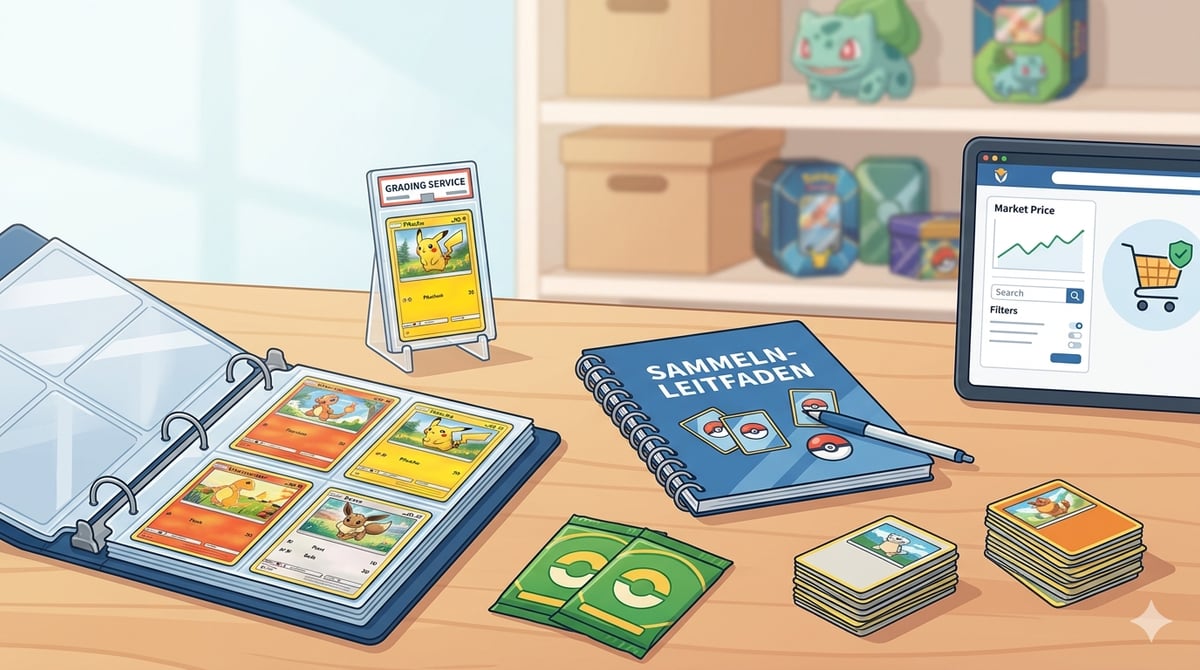
You probably didn't plan to get into Pokémon cards. Maybe you saw an article about a card selling for half a million dollars. Maybe a coworker mentioned they still had their childhood collection somewhere. Or maybe you just wanted to buy a booster pack for nostalgia and found yourself two hours later falling down a rabbit hole on eBay.
Welcome. You're not alone — and you're not too late.
The Pokémon card hobby has never been more accessible to beginners, and it's never been more financially significant at the top. That combination makes it simultaneously exciting and confusing to enter. There's a lot of noise: hype around modern sets, Instagram posts about enormous sales, contradictory advice from Reddit and Discord.
This guide exists to cut through that noise. We'll cover the three eras you need to understand, how to decide what kind of collector you want to be, how grading works and why it matters so much, where to buy safely, and the classic mistakes that cost beginners money. By the end, you'll have enough knowledge to take your first steps with confidence.
First: Understand the Three Eras
One of the most common beginner mistakes is treating all Pokémon cards as essentially the same thing with different price tags. They're not. The market functions almost like three distinct hobbies stacked on top of each other, and the rules — for investing, collecting, and buying — are meaningfully different across eras.
The WOTC Era (1999–2002)
This is where the hobby started, and it's still where the serious investment and collector money moves.
Wizards of the Coast (WOTC) held the Pokémon TCG license from the beginning, producing the Base Set, Jungle, Fossil, Team Rocket, and others before losing the license to Nintendo in 2003. Those sets were printed in limited quantities by modern standards — nobody knew Pokémon was going to become a multi-billion dollar franchise — which means the supply of surviving cards in good condition is genuinely finite and declining.
A Near Mint Charizard from this era is now a premier collectible. But even the less glamorous cards from this period — your Snorlax, your Alakazam, your Gyarados — have appreciated significantly at high grades because the fundamentals are sound: fixed supply, growing collector demand, and the most powerful nostalgia premium in the hobby.
The Middle Era (2003–2019)
When Nintendo took the license back, a new chapter began. The EX Series, Diamond & Pearl, HeartGold & SoulSilver, Black & White, XY, Sun & Moon — seventeen years of sets that produced genuinely beautiful cards with their own passionate collector communities.
For most beginners, this era is excellent for learning. Prices are more accessible than WOTC, condition still matters and is worth understanding, and there's enough sales volume to develop genuine price intuition.
The Modern Era (2020–Present)
The pandemic-era interest explosion brought an enormous wave of new players, collectors, and investors simultaneously — and print runs expanded dramatically to meet demand. Sword & Shield, Scarlet & Violet, and the sets that follow have produced genuinely beautiful cards, but also in very large quantities.
That matters for investment. Large print runs mean more volatile prices and less likelihood of the long-term compounding appreciation that vintage cards can produce. If someone advises you to buy modern booster packs as an investment strategy, understand what you're getting into.
The most important beginner takeaway: Pick one era to learn first. Not three — one. Mastering the pricing, the grading dynamics, and the culture of one era before expanding is how you avoid expensive mistakes.
Decide Why You're Really Collecting
Collecting for Nostalgia and Enjoyment
If you're here because you loved Pokémon as a kid and want to recapture that feeling — great. It's the most honest and arguably most satisfying reason to collect.
Focus on the cards and sets that actually meant something to you. Buy grades you can afford without financial strain. Prioritize the enjoyment of having the cards over optimizing returns. And don't let anyone convince you that you need to be serious about it.
Collecting as Investment
If you're drawn by the financial opportunity — the real, documented returns on quality vintage cards — you approach things differently, and that's legitimate.
Investment-focused collecting demands more discipline, more research, and a longer time horizon than most people imagine. Serious vintage card investments play out over 3–7 years, not 3–7 months.
Set Completion
There's a specific and deeply satisfying form of collecting that involves completing a whole set — every card from the Base Set, for example. Set collectors are often the most knowledgeable people in the hobby because they've had to research every card in a set deeply.
Understand Grading: Why Condition Changes Everything
If there's one concept that separates experienced collectors from beginners, it's a deep understanding of how much condition affects value.
Here's a concrete example: a 1999 Base Set Charizard in PSA 7 condition is worth approximately €9.300 – 13,000. The same card in PSA 9 is worth €41.850 – 74,000. PSA 10? €279.000 – 465,000+.
Same card. Same set. Same artwork. The condition premium in Pokémon cards is unlike almost any other physical collectibles market.
How the PSA Grading Scale Works
PSA (Professional Sports Authenticator) is the most widely recognized grading service in the Pokémon card market. They grade cards on a 1–10 scale based on four factors: centering, corners, edges, and surface.
| Grade | Label | What It Typically Means | Investment Value |
|---|---|---|---|
| PSA 10 | Gem Mint | Near-flawless in all respects | Maximum premium |
| PSA 9 | Mint | Very minor imperfections under loupe | Strong premium |
| PSA 8 | NM-MT | Slight wear visible under close examination | Solid investment grade |
| PSA 7 | Near Mint | Minor surface wear | Collector grade |
| PSA 6 | EX-MT | Noticeable but not distracting wear | Hobby collections |
| PSA 5 and below | Good to Excellent | Clearly visible wear | Play copies/display |
For beginners, the PSA 5–8 range is where you'll spend most of your learning time, because prices are accessible and condition differences are easier to see and understand.
PSA vs. BGS vs. CGC: Which Service Matters?
PSA is the market standard — their slabbed cards carry the strongest secondary market premium and the deepest buyer base when you want to sell. BGS (Beckett) is more detailed with sub-grades, and their Pristine 10 designation commands real premiums for ultra-high-value cards. CGC is newer, faster, and more affordable, with growing acceptance but not yet PSA-equivalent status.
Where to Buy: Sources Ranked by Trust and Safety
Highest Trust
TCGPlayer — The largest dedicated card marketplace in the US, with meaningful buyer protection policies and genuinely useful historical price data for research purposes. For modern cards, it's the default. -> TCGPlayer
Heritage Auctions, Goldin, and PWCC — For high-value vintage, specialized auction houses provide provenance and verification that an ordinary listing can't match. These aren't where you buy your first cards, but when you're ready for significant vintage purchases, they're the safest venues.
Official Pokémon Center — The safest source for new retail product — factory sealed, authentic, no complications.
Established local card shops — The ability to physically examine a card before buying is valuable, especially while you're developing your own authentication instincts.
Medium Trust
eBay has buyer protection policies that help, but the sheer volume of listings means fakes and misrepresented cards exist in real numbers. Always buy from sellers with strong feedback specifically for Pokémon transactions, and verify rated cards by looking up the cert number on psacard.
Starting Budget: How to Allocate Your First €465 – 2,000
Under €465: This is learning money, and it should be treated like it. Focus on buying 3–5 PSA 7–8 graded cards from a set you care about, from a trusted source. Your goal isn't to generate returns — it's to understand how cards feel, how grading works in practice, and what price research actually looks like.
€465 – 1,000: You can start building real foundations. Consider spreading across 5–10 graded cards in the PSA 7–9 range, preferably WOTC-era holos with consistent sales history.
€930 – 2,000: You now have enough to take 1–2 meaningful positions in cards with investment-grade fundamentals. A PSA 8 holo from the Base Set era of a character you like, bought at a fair price based on recent comps, is a reasonable first investment purchase.
Physical Storage: Protect What You Own
For ungraded cards: Double-sleeve. A penny inner sleeve plus a harder outer sleeve or top loader. Store in a cool, dry place away from direct sunlight. 45–55% relative humidity is ideal; below 35% causes brittleness, above 65% encourages warping and mildew.
For graded cards (slabs): PSA and BGS slabs are protective but not invulnerable. Direct sunlight fades cards even through the case. Temperature fluctuations cause cardboard expansion and contraction, which can create surface issues over time.
Common Mistakes That Cost Beginners Real Money
Buying booster packs as an investment vehicle. Opening packs is fun. It's also, statistically, an expensive way to acquire cards compared to buying the specific cards you want directly. The expected value of a booster pack is typically below its retail price once you account for the distribution of pulls.
Chasing current hype. The card spiking this week, the set everyone's talking about right now — those are the cards where you're most likely to buy at the top of a speculative move.
Buying ungraded vintage from unknown sellers. Fake Pokémon cards have become genuinely sophisticated. Learn authentication properly (see our guide to spotting fakes) or buy graded from trusted sources.
Ignoring your cost basis. If you're not tracking what you paid for each card — including grading fees and shipping — you can't calculate real returns. Tracking from day one is a discipline beginners almost universally skip and almost universally regret.
Over-diversifying too early. It's tempting to spread €465 across 20 different cards because diversification sounds smart. In practice, spreading thin before you've developed price intuition usually means buying all of those 20 cards at suboptimal prices.
Your First-Week Action Plan
Choose your collection focus. One era, one goal (nostalgia, investment, set completion, or play). Write it down.
Study 20 recently sold listings. Not asking prices — sold listings. On TCGPlayer, look at price history. On eBay, filter to "Sold" listings. For cards you're interested in, understand what they're actually trading for.
Create a free psacard account for PSA population reports on psacard. Look up cards you're interested in. How many PSA 9s exist? PSA 10s? That context will inform every subsequent purchase decision.
Join a community. Reddit's r/r/PokemonTCG is the most active general community. You'll learn faster by observing and asking questions than by reading guides alone.
Don't buy anything yet. Give yourself two weeks of pure learning before spending money. The cards you want will still be there, and you'll buy them better after waiting.
Start with a digital inventory. Set up a collection tracking tool early so you can log your first purchases from day one. Knowing what you have and what it's worth is the foundation of smart collecting.
Read Next
- How to Spot Fake Pokémon Cards — Essential reading before buying any vintage
- The 10 Most Valuable Pokémon Cards in 2026 — Understand the top of the market