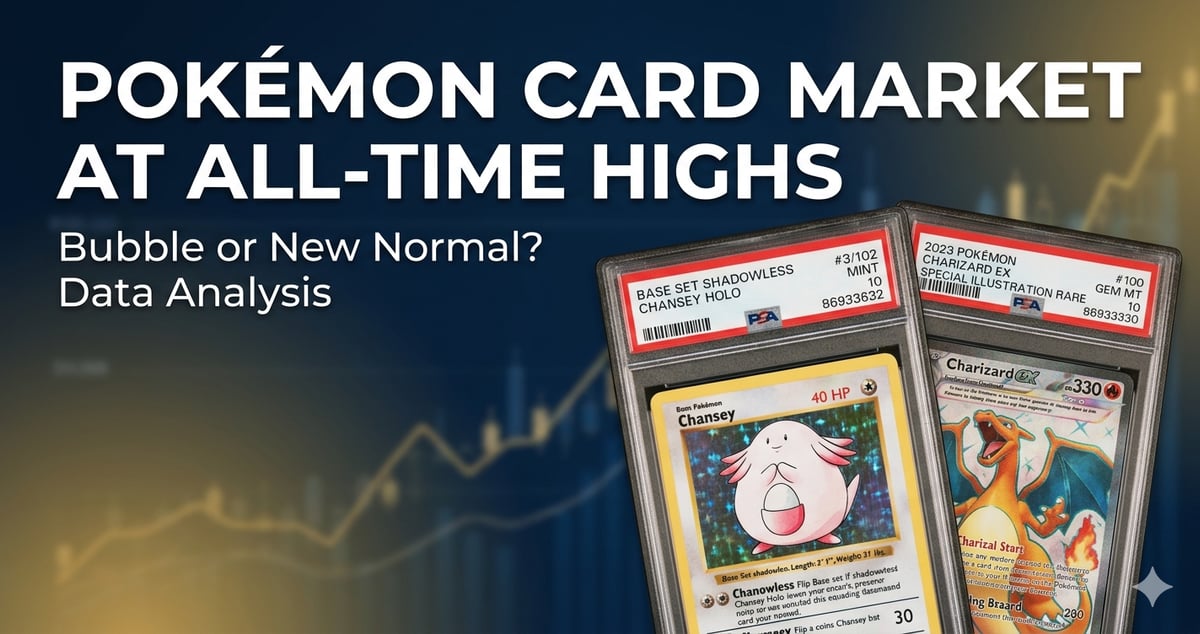
The Pokémon card market has never been worth more than it is right now.
Between the Mega Evolution era reshaping competitive play, the 30th Anniversary set announcement driving unprecedented demand, and institutional money flowing into the hobby at record rates, prices across nearly every category have surged to all-time highs in 2026.
But anyone who lived through the 2021 boom—and the 30–40% correction that followed—knows that "all-time highs" can precede painful drawdowns.
So which is it? Are we witnessing a speculative bubble about to burst, or has the Pokémon card market permanently established a higher price floor?
This article examines the evidence on both sides, analyzes what history tells us, and gives you a framework for protecting your collection's value regardless of which scenario plays out.
The Numbers Behind the Surge
Before debating "bubble or new normal," let's establish what's actually happening.
Market-level data:
- The global Pokémon TCG market exceeded €9,58 billion in 2025, up from €4,37 billion in 2019
- Heritage Auctions' Pokémon category revenue grew 34% year-over-year through Q1 2026
- Average PSA submission volume for Pokémon cards increased 22% in the first quarter of 2026 versus the same period in 2025
- The Mega Evolution era (launched late 2025) drove the highest booster box first-week sales since Evolving Skies
Individual card benchmarks:
- PSA 10 Base Set Charizard: trading around €260.400 – 298,000 (up from €186.000 in early 2025)
- PSA 10 Gold Star Rayquaza: €41.850 – 51,000 range (up 40% year-over-year)
- Modern chase cards (SARs, MURs) from Mega Evolution sets: holding value 3–6 months post-release at rates not seen since Crown Zenith
These aren't marginal gains. This is a market moving structurally upward.
The Case for "New Normal": Why Prices May Stay High
1. Institutional Money Has Arrived—and It Doesn't Leave Quickly
The most significant development in the Pokémon card market over the past three years is the arrival of institutional capital. When Heritage Auctions, Sotheby's, and Christie's regularly feature Pokémon cards alongside fine art and vintage watches, it signals permanent legitimacy.
Institutional investors don't panic-sell. They have long investment horizons, professional storage, and structured exit strategies. Their presence creates a price floor that didn't exist during the 2020–2021 retail-driven boom.
Key indicators:
- Multiple dedicated Pokémon card investment funds now operate with €9.300.000+ AUM
- Corporate collection services have emerged (professional-grade storage, insurance, portfolio management)
- Auction house participation has expanded beyond one-off events to regular scheduled sales
2. The Pokémon Franchise Is Uniquely Durable
Pokémon isn't just a card game. It's the highest-grossing media franchise in history—ahead of Star Wars, Marvel, and Disney—with over €93 billion in lifetime revenue.
The franchise generates new fans every generation while retaining older ones. A 35-year-old who collected Base Set cards in 1999 now has disposable income and nostalgia. Their 10-year-old child is discovering Pokémon for the first time through Scarlet & Violet and the TCG's Mega Evolution era.
This multi-generational demand cycle is something most collectibles markets lack. Baseball cards appeal to a narrowing demographic. Comic books face digital competition. Pokémon continuously creates new entry points.
3. Vintage Supply Is Mathematically Fixed
Here's the fundamental argument for sustained high prices on vintage cards: supply cannot increase.
Every Base Set Charizard that exists was printed between 1999 and 2000. No more will ever be made. Meanwhile, the cards that exist are being:
- Damaged through play and poor storage
- Lost, discarded, or destroyed
- Locked in PSA slabs and held long-term by institutions
The graded population for high-grade vintage cards actually decreases over time as cards are lost or regraded lower. When supply contracts and demand grows, prices rise. This isn't speculation—it's economics.
4. The 2026 Catalysts Are Real
The convergence of events in 2026 is genuinely unprecedented:
- Mega Evolution era: The return of a beloved mechanic has brought competitive players AND nostalgic collectors back simultaneously
- 30th Anniversary set (September 2026): This milestone is driving pre-emptive buying across vintage categories
- Chaos Rising (May 2026): High-quality chase cards maintaining collector interest
- Global events: Pokémon Mega Festa drew 40,000+ attendees in Korea alone—demand is global
The Case for "Bubble": Warning Signs You Shouldn't Ignore
1. We've Seen This Movie Before
The 2020–2021 Pokémon card boom was fueled by pandemic stimulus, influencer hype (Logan Paul's viral box breaks), and retail FOMO. Prices for many cards doubled or tripled in months.
Then came the correction. PSA 10 Base Set Charizard fell from €343.170 (March 2022) to around €186.000 by mid-2023. Modern cards like Rainbow Rare Charizard VMAX lost 50–60% of peak value.
The lesson: Markets driven by sentiment can correct sharply when sentiment shifts. While the current surge has stronger fundamentals than 2021, the speed of price appreciation is reminiscent of that era.
2. Modern Card Print Volumes Are Massive
While vintage cards have fixed supply, modern cards do not. Pokémon Company International has significantly increased print runs to meet demand, but "meeting demand" also means creating enormous future supply.
The risk: A PSA 10 Mega Charizard ex SAR from 2026 may have thousands of copies graded within five years. Compare that to Base Set, where total PSA 10 population for the Charizard is under 500 copies ever.
High print volumes don't prevent short-term gains (scarcity at release), but they threaten long-term appreciation for modern cards specifically.
3. Speculation vs. Genuine Collecting
Not everyone buying Pokémon cards today is a collector. The rise of "card investing" content on YouTube, TikTok, and Reddit means a significant portion of buyers are speculating—purchasing cards purely for expected price appreciation.
Speculative demand is fragile. When prices stop rising, speculators exit, creating selling pressure that accelerates declines. If you doubt this, look at the NFT market, which shared many characteristics with the 2021 card boom.
4. The Broader Economic Context
Pokémon cards don't exist in an economic vacuum. Rising interest rates, inflation concerns, and potential recession risks all affect discretionary spending on collectibles.
During the 2022 correction, cards declined alongside equities and other risk assets. If broader economic conditions deteriorate, Pokémon cards—as a luxury discretionary purchase—would likely face headwinds regardless of hobby-specific fundamentals.
What History Teaches Us: It's Probably Both
The most honest answer to "bubble or new normal?" is: it depends on which part of the market you're examining.
The 1999–2003 Pokémon Cycle
The original Pokémon card boom peaked around 1999–2000 and crashed through 2003 as the franchise's cultural moment passed. Cards that sold for hundreds became worth single dollars.
But then something happened: Pokémon didn't die. The franchise continued producing games, shows, and cards. By 2010, those "worthless" Base Set cards began appreciating. By 2020, they were worth more than at their 1999 peak.
The pattern: Short-term corrections happen. Long-term demand for iconic Pokémon cards trends upward. The key is surviving the corrections.
The Sports Card Parallel
The sports card market experienced a similar boom in 2020–2021, corrected 30–50% through 2022–2023, and has since stabilized at levels significantly above pre-boom prices.
The new "floor" is higher than the old ceiling. That's the "new normal" pattern—but getting there involved a painful correction first.
What This Means for 2026
Applying historical patterns to the current market:
- Current prices may be ahead of fair value for some categories (especially modern speculation-driven cards)
- A correction of 15–25% is plausible within the next 12–18 months
- Post-correction prices will likely remain above 2024 levels due to structural demand improvements
- Vintage and iconic cards will recover fastest because of fixed supply
Which Categories Are Most Vulnerable?
Not all Pokémon cards face equal risk. Here's a category-by-category assessment:
Low Risk (Protected by Fundamentals)
| Category | Why It's Protected |
|---|---|
| WOTC 1st Edition (PSA 8+) | Fixed supply, institutional demand, cultural iconography |
| Gold Star cards (PSA 9+) | Extremely low population, cross-era collector appeal |
| Trophy cards | Unique/near-unique supply, museum-quality demand |
Medium Risk (Could Correct 15–25%)
| Category | Risk Factor |
|---|---|
| Modern SARs/MURs | High print volumes offset by strong current demand |
| Sealed booster boxes (modern) | Supply is high but diminishes over time |
| Japanese exclusives | Dependent on import demand continuing |
High Risk (Could Correct 25–40%)
| Category | Risk Factor |
|---|---|
| Speculation-driven modern singles | No collector floor, pure sentiment |
| Influencer-hyped cards | Demand evaporates when content creators move on |
| Bulk graded modern cards | PSA population growth outpaces demand |
How to Protect Your Collection Regardless
Whether we're in a bubble or a new normal, these strategies protect your portfolio:
1. Diversify Across Eras
Don't concentrate entirely in modern OR vintage. A balanced portfolio weathers corrections in either category.
2. Prioritize Liquidity
Hold cards with proven sales volume. A card that trades 50+ times per month on TCGplayer or Cardmarket will always find a buyer, even in downturns.
3. Track Your Portfolio Value Consistently
You can't make informed decisions without data. Use collection tracking tools to monitor your collection's value in real time—so you see shifts as they happen, not after the fact.
4. Set Mental Stop-Losses
Decide in advance: "If this card drops 20%, I'll reassess." Emotional selling during corrections is the #1 value destroyer.
5. Focus on What You Love
The collectors who survived every correction in history are the ones who genuinely love their cards. Speculators exit when prices drop. Collectors hold—and they're rewarded in the long run.
The Bottom Line
The Pokémon card market at all-time highs in 2026 is supported by stronger fundamentals than any previous peak—institutional demand, franchise durability, fixed vintage supply, and genuine milestone catalysts.
But "stronger fundamentals" doesn't mean "immune to correction." Historical patterns suggest a period of consolidation or pullback is likely before the market establishes its next sustained floor.
The smart play isn't picking "bubble" or "new normal" and betting everything on it. It's building a diversified, liquid portfolio that you track carefully, positioning yourself to benefit from long-term appreciation while surviving short-term volatility.
Want to learn more about smart Pokémon card investing? Check out our Ultimate Guide to Building a Pokémon Card Investment Portfolio and How to Predict Pokémon Card Value Fluctuations.