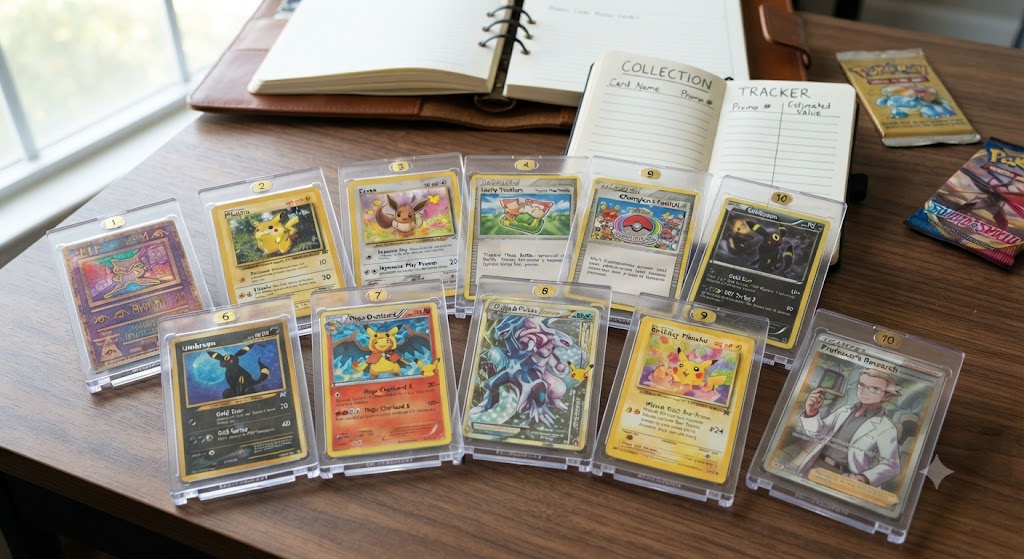
Most collectors ignore promo cards. That's a mistake.
Promo cards don't belong to any numbered set. They come from Pokémon Center exclusives, stamp boxes, league rewards, and movie screenings. Because they're distributed outside booster packs, they follow completely different supply dynamics. That's exactly why a few of them have quietly become some of the most valuable cards in the Pokémon TCG.
A Pikachu from a 2018 Japanese Pokémon Center stamp box now trades for over €300 on Cardmarket. A Pikachu Illustrator, technically a promo from 1998, sold for $6 million at auction. Even modern ETB-exclusive promos, the kind you get for free with a €50 purchase, are climbing 15–30% within the first year of release.
After analyzing price data across thousands of promo card transactions, our take is simple: not all promos are created equal, but the ones with real scarcity, standout artwork, and steady demand outperform most set cards. We think that gap will keep widening as modern set print runs grow.
Why Promo Cards Are Different
The Supply Ceiling Problem
Set cards come from booster packs. Open enough packs, and the supply is relatively predictable. Promo cards break this model entirely.
A Pokémon Center exclusive promo might have a print run of 50,000–200,000 units worldwide. A stamp box promo from Japan was distributed to a handful of Pokémon Center locations for a limited window. League promos were given out at participating game stores for a specific season. Then they simply stopped.
This creates a fundamentally different scarcity profile. Set cards can be pulled from any booster box of that set. Promos exist in fixed supply, and that supply only shrinks as cards get damaged, lost, or locked in permanent collections.
Demand Mechanics
Promos also benefit from a collector psychology that set cards don't always trigger. A promo card tied to a specific event, like a movie screening, a Pokémon Center grand opening, or a league championship, carries emotional weight. Collectors aren't just buying a card. They're buying proof that they were there.
This dual driver of scarcity and emotional demand is what separates promos worth €50 from promos worth €500.
The 10 Best Promo Cards to Invest In
Stamp Box Promos (Japanese Pokémon Center)
These are the crown jewels of the promo market. Japanese Pokémon Center stamp boxes included exclusive cards that were never released in any other format. Their distribution was geographically limited and time-boxed, creating genuine scarcity.
| Card | Year | Approx. Cardmarket Price (July 2026) | Condition |
|---|---|---|---|
| Pikachu (Stamp Box) | 2018 | €310–€380 | NM-Mint |
| Eevee (Stamp Box) | 2018 | €185–€240 | NM-Mint |
| Pikachu (CoroCoro) | 2019 | €140–€190 | NM-Mint |
| Mew (Stamp Box) | 2020 | €95–€130 | NM-Mint |
| Charizard (CoroCoro) | 2019 | €200–€270 | NM-Mint |
The 2018 Pikachu Stamp Box is the benchmark. It started at roughly €60 on release and has more than quintupled in six years. The Eevee has followed a similar trajectory: €40 at release to €185–€240 now. These cards benefit from the triple combination of Japanese exclusivity, limited distribution window, and iconic artwork.
Pokémon Center ETB-Exclusive Promos
Modern ETBs from Pokémon Center often include a promo card exclusive to their store. These have become increasingly popular as investment pieces because the entry cost is low and the distribution window is finite.
| Card | Product | Approx. Cardmarket Price (July 2026) | Original Retail |
|---|---|---|---|
| Charizard ex (Obsidian Flames) | PC ETB | €55–€70 | ~€50 |
| Pikachu (151) | PC ETB | €40–€55 | ~€50 |
| Gardevoir ex (Paldea Evolved) | PC ETB | €35–€48 | ~€50 |
| Mew ex (151) | PC ETB | €30–€42 | ~€50 |
The pattern is simple: Pokémon Center ETB promos trade at or above the ETB's original retail price. That means you essentially get eight booster packs plus accessories for free. The promo alone covers your cost. We expect these numbers to keep climbing as supply dries up and grading demand pulls more copies into permanent slabs.
Movie and Event Promos
Movie screening promos carry nostalgia weight that few other cards can match. They're tied to a specific cultural moment, and cultural moments don't get reprinted.
| Card | Event | Approx. Cardmarket Price (July 2026) | Notes |
|---|---|---|---|
| Pikachu (Detective Pikachu) | Movie screening 2019 | €25–€40 | Widely available but steady demand |
| Mew (Promo) | Various distributions | €35–€55 | Multiple versions, PSA 10 premium |
| Lugia (Neo Genesis promo) | League event | €80–€120 | Vintage, limited league distribution |
| Dark Gyarados (Holo promo) | WOTC-era | €55–€85 | Nostalgia-driven, iconic artwork |
Professor's Research and League Promos
These are the quiet accumulators. League promos were distributed at local game stores, often in small quantities per location. A Professor's Research promo, given away as a league participation reward, might have only 10,000–30,000 copies in circulation. They're not flashy, but they appreciate steadily. Well-maintained copies gain 8–15% annually.
How to Evaluate a Promo Card's Investment Potential
We use three factors to assess whether a promo card is worth your money:
1. Scarcity
How many were printed? Was the distribution geographically limited (Japan-only stamp box vs. global movie promo)? Was the window time-boxed (one-week stamp box vs. month-long movie promotion)? The narrower the distribution, the higher the scarcity premium.
2. Demand
Is the character iconic? Pikachu, Charizard, and Eevee consistently command higher premiums than less popular Pokémon. Does the card tie to a specific event or cultural moment? Collector psychology favors cards with a story.
3. Grading Potential
Cards that grade PSA 10 or 9 can see value multiply by 3–10x. Check the card's print quality. Japanese promo cards often have better centering and surface quality than their Western counterparts. A stamp box Pikachu that grades PSA 10 can be worth 4–5x a raw copy.
Promo Cards vs. Set Cards: Appreciation Comparison
| Category | Avg. Annual Appreciation | Supply Model | Entry Cost |
|---|---|---|---|
| Stamp Box Promos | 15–25% | Fixed, limited, regional | €40–€400 |
| Pokémon Center ETB Promos | 10–18% | Fixed, moderate run | €35–€70 |
| Movie/Event Promos | 8–15% | Variable, often larger runs | €15–€120 |
| League Promos | 8–15% | Fixed, very limited per location | €10–€80 |
| Modern Chase Set Cards | 5–12% | Reprintable, high print run | €15–€200 |
| Vintage Set Cards (PSA 10) | 12–20% | Fixed, declining | €200–€5,000+ |
Promos consistently outperform modern chase set cards on an appreciation percentage basis. The fixed supply model is the primary driver, but the emotional demand factor adds a premium that pure numbers don't fully capture.
For a deeper look at how to structure a portfolio that includes both promos and set cards, see our complete portfolio investment guide.
Where to Buy Promo Cards
Cardmarket
Cardmarket is the primary marketplace for European collectors. Promo cards are listed under individual seller inventories, and prices vary significantly by condition. Filter by "Near Mint" or "Slightly Played" for investment-grade copies.
eBay
eBay offers broader global access, especially for Japanese promos that may not appear on Cardmarket. Watch for seller ratings and photo verification. Auction listings can yield below-market prices for patient buyers.
Local Game Stores
League promos and Professor's Research cards sometimes appear in local game store bargain bins or trade binders. Building relationships with store owners can give you first access to these under-the-radar cards.
Regardless of where you buy, protecting your promo cards during transport and storage is critical. Toploaders and penny sleeves are the minimum. A single surface scratch or bent corner can drop a PSA 10 candidate to a 9, cutting the card's value by 50–80%. For higher-value promos, consider semi-rigid card holders like Card Savers, which are also the submission standard for PSA and BGS grading.
Grading Submissions
If you have raw promo cards in excellent condition, consider submitting to PSA or BGS for grading. A PSA 10 stamp box Pikachu can be worth 4–5x a raw copy. The grading fee is often recovered in the first sale. PriceCharting can help you track graded card values over time.
Common Mistakes to Avoid
Buying ungraded promos at graded prices. A raw Pikachu stamp box card is worth €310–€380 in NM condition. Don't pay that for a card with visible centering issues or edge wear.
Ignoring Japanese exclusives. The best promo investment returns consistently come from Japanese-market cards. Language doesn't reduce value. It increases it.
Chasing modern movie promos too early. Detective Pikachu promos are widely available. They're stable investments but not high-growth plays. The big returns come from promo cards with genuinely limited distribution.
Skipping the research. Before buying any promo, check the print run, distribution method, and current Cardmarket pricing. See our sealed products investment guide for how limited supply drives value in the Pokémon market.
📊 Track your promo card values with CardTrezor, the free portfolio tracker with live Cardmarket prices. Start tracking free
Read Next
- Build a €10K Pokémon Portfolio: Free Tracker with Live Cardmarket Prices. Structure a portfolio that mixes promos, vintage, and sealed products
- PSA 10 vs. Raw Cards: When Is Grading Worth It in 2026?. Learn when grading multiplies your promo card's value
This article contains affiliate links. We may earn a small commission at no extra cost to you.