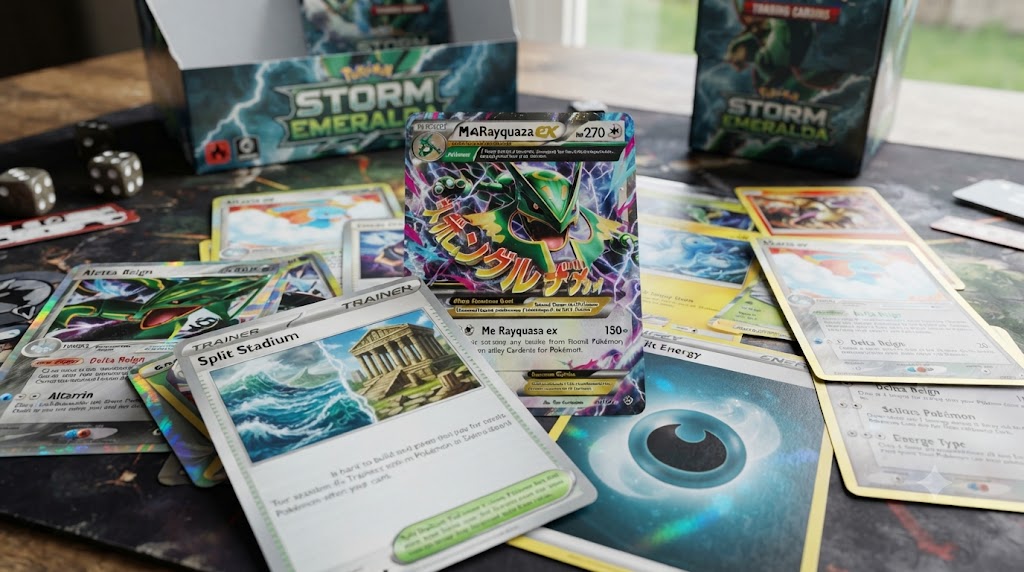
The Mega Evolution era has already delivered Chaos Rising, Pitch Black, and some of the most valuable modern Pokémon cards we've seen in years. But Storm Emeralda might shake up both the meta and the market again.
Due for Japanese release on July 31, 2026, Storm Emeralda (M6) introduces something the Pokémon TCG hasn't seen since the Lost Zone mechanic debuted years ago: an entirely new card type. The "Legendary Summit" split stadium card lets two stadium effects coexist on the field simultaneously, a gameplay shift that could reshape competitive play and collector demand in equal measure.
And at the center of it all sits Mega Rayquaza ex, the single most popular Pokémon for collectors worldwide, now returning in its most powerful form yet. This preview covers the chase card prices, the split stadium mechanic, and the sealed product outlook for both Storm Emeralda and Delta Reign.
Set Overview
Storm Emeralda is the seventh set in the Mega Evolution era (catalog number M6 in Japan) and is based on the Japanese release of the same name. The English version, Delta Reign, is scheduled for November 6, 2026.
Key Details
| Detail | Value |
|---|---|
| Japanese name | Storm Emeralda (M6) |
| Japanese release | July 31, 2026 |
| English name | Delta Reign |
| English release | November 6, 2026 |
| Total cards | ~115 (76 main + 35–40 secret rare) |
| Flagship card | Mega Rayquaza ex SAR |
| New mechanic | Split Stadium ("Legendary Summit") |
The set slots between Pitch Black (SV8, July 17) and the 30th Anniversary Celebration (September 16). That timing is significant: Storm Emeralda bridges the gap between the current Mega Evolution block and what promises to be one of the biggest celebrations in Pokémon TCG history.
With approximately 115 cards, it matches the size of both Chaos Rising and Pitch Black. But the addition of the split stadium mechanic gives it something neither of those sets had: a new way to play the game.
The Split Stadium Mechanic
The biggest talking point coming out of Storm Emeralda is a card type. The "Legendary Summit" split stadium is the first new card mechanic introduced since the Lost Zone changed how players think about resource management.
How It Works
In standard Pokémon TCG rules, only one stadium card can be in play at a time. When a new stadium is played, the previous one is discarded. The split stadium breaks this rule entirely.
A Legendary Summit card has two distinct effects, one for each player. Both effects can coexist on the field simultaneously, meaning the card doesn't replace an opponent's stadium. It shares the space. This creates a fundamentally different dynamic where both players benefit (or are affected) by the same card.
Why This Matters
The Lost Zone looked niche when it first appeared, a holding area for removed cards. Within months, it had spawned entire archetypes, forced competitive metagame adaptation, and produced some of the most sought-after collector cards of its era.
The split stadium mechanic has similar breakout potential. If even a handful of Legendary Summit cards are competitively viable, the set becomes essential for players. Player demand is one of the strongest drivers of sustained set value over time.
For collectors, the first set to introduce a major mechanic tends to carry premium value. The initial run of Lost Zone cards from Astral Radiance still trades well above comparable non-mechanic cards from the same era. We expect Storm Emeralda's Legendary Summit cards to follow the same pattern.
Top Chase Cards
The Japanese market has already started pricing Storm Emeralda chase cards, and Mega Rayquaza ex is commanding a premium that reflects both the Pokémon's popularity and the card's artwork.
Chase Card Price Estimates
| Card | Japanese Price (¥) | Estimated English Price (€) |
|---|---|---|
| Mega Rayquaza ex SAR | ¥35,000–50,000 | €210–€300 |
| Mega Rayquaza ex regular art | ¥8,000–12,000 | €50–€75 |
| Illustration Rare variants | ¥5,000–15,000 | €30–€90 |
| Legendary Summit trainer cards | ¥3,000–8,000 | €20–€50 |
The SAR (Special Art Rare) variant of Mega Rayquaza ex is the clear chase. At ¥35,000–50,000 (approximately €210–€300), it's priced significantly above most Mega Evolution SAR cards from earlier sets, though below the MUR tier seen in Pitch Black's Mega Darkrai ex.
What makes this card special is the artwork. Rayquaza's serpentine form is a natural fit for full-illustration treatments, and early leaks suggest the SAR captures the Pokémon in its signature aerial pose with dramatic weather effects. For context, even non-SAR Rayquaza cards from older sets like Roaring Skies carry a collector premium simply because of the Pokémon's popularity.
Investment Angle
The SAR is the realistic chase for most collectors. Pull rates for SAR-tier cards in the Mega Evolution era typically sit around 1 in 20 booster boxes for any specific card. That rarity holds value, but enough copies reach the market to establish stable pricing.
Why Rayquaza Matters for Collectors
Rayquaza occupies a specific and powerful position in the collector hierarchy, consistently one of the top three most popular Pokémon alongside Charizard and Pikachu.
Historical Performance
Mega Rayquaza ex from Primal Clash (2015), one of the original Mega Evolution era sets, still trades at significant premiums a decade later:
| Card | Set | Year | Price Then | Price Now (2026) |
|---|---|---|---|---|
| Mega Rayquaza ex FA | Primal Clash | 2015 | ~€40 | €80–€120 |
| Mega Rayquaza ex (regular) | Primal Clash | 2015 | ~€15 | €30–€50 |
| Rayquaza VMAX Alt Art | Evolving Skies | 2021 | ~€80 | €150–€250 |
Evolving Skies is the most relevant comparison. That 2021 set was dominated by Rayquaza VMAX Alt Art, which became one of the most expensive modern Pokémon cards ever printed. The set itself benefited enormously from Rayquaza demand. Booster boxes that retailed for ~€100 now trade well above that on Cardmarket.
Storm Emeralda carries the same dynamic: a beloved Pokémon in its most powerful form, anchoring an entire set's collector identity. Evolving Skies shows this formula works.
Japanese Market Signals
Rayquaza consistently outperforms other Legendaries in the Japanese market. Japanese collectors place a premium on dramatic artwork and competitive viability, both boxes that Mega Rayquaza ex checks. The early pricing of ¥35,000–50,000 for the SAR, before the full set is even confirmed, signals strong baseline demand.
Investment Implications
Storm Emeralda sits at a fascinating intersection of set cycles, anniversary hype, and collector psychology. Four signals will decide whether this set pays off for investors: Japanese pre-order prices, the English pre-order window, the 30th anniversary timing, and sealed product demand.
Japanese Pre-Order Prices as Leading Indicator
Japanese pre-order prices for Storm Emeralda products are the best early signal of demand strength. If booster boxes stay above ¥5,500 (the typical MSRP), it indicates collector confidence. If they spike above ¥7,000, expect the English version to carry significant secondary market premiums.
Track these prices on Cardmarket and Japanese platforms as they update through July.
English Pre-Order Window
Delta Reign's November 6 release means English pre-orders will likely open in September, right when the 30th Anniversary Celebration set drops. This is a double-edged sword:
- Positive: Anniversary hype brings new collectors into the hobby, and those collectors will need Storm Emeralda cards for competitive decks
- Risk: Anniversary set marketing could overshadow Delta Reign, potentially softening pre-order demand
The 30th Anniversary Factor
The 30th Anniversary Celebration (September 16) is expected to be the biggest Pokémon TCG release of the year. Storm Emeralda/Delta Reign benefits from the increased attention on the hobby but also competes for collector budgets. Sets that bridge anniversary cycles, releasing close enough to ride the wave but far enough to avoid direct competition, tend to perform well long-term.
Sealed Product Strategy
If you're looking at sealed product investment:
- Japanese booster boxes: Buy at or near MSRP if possible. Japanese sealed product from the Mega Evolution era has historically appreciated well.
- English ETBs: Pokémon Center exclusive ETBs are the best long-term sealed product. Get them at MSRP if you can.
- Booster boxes: The standard play. Buy at release, hold for 2–3 years minimum.
 Pokémon TCG: Storm Emeralda Japanese Booster Packs (5 Sealed Packs, Mega Rayquaza ex)Buy on Amazon →
For any sealed product you plan to hold, proper storage is essential. An Elite Trainer Box display case or booster box storage container protects against humidity, light, and physical damage, all of which can erode the sealed premium that makes these products worth holding in the first place.
 Acrylic Display Case for Pokémon Elite Trainer Box (ETB), 5mm UV-ResistantBuy on Amazon →
📊 Track your Delta Reign pulls with CardTrezor: the free portfolio tracker with live Cardmarket prices. Start tracking free
Affiliate Disclosure: CardTrezor is a participant in the Amazon EU Associates Programme. We earn from qualifying purchases. This article contains affiliate links.
Read Next
- The Mega Evolution Era: What It Means for Collectors and Investors in 2026: Full context on where Storm Emeralda fits
- Pitch Black 2026 Guide: Mega Darkrai ex, Pull Rates & Best Products: The current set in stores now