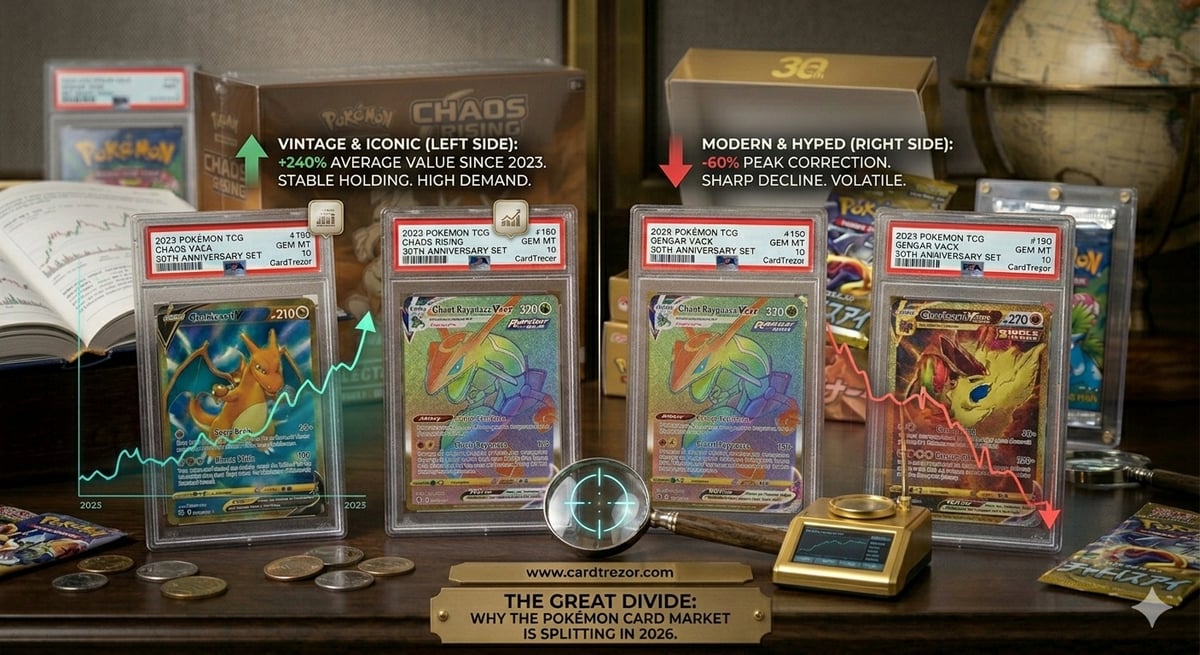
The Pokémon card market in 2026 is telling two completely different stories.
Walk into any card shop or browse Cardmarket, and you'll witness a phenomenon that's defining the year: a market splitting down the middle. On one side, vintage PSA 10s are setting record after record. A Rayquaza Star from EX Deoxys jumped 180% in a single week of trading. A Shining Charizard from Neo Destiny recently sold for $4,621 (€4,298), double its value from just six months prior. Heritage Auctions reported that their Q2 2026 Pokémon auction saw 47% of lots selling above their high estimates, almost exclusively in the PSA 9 and PSA 10 categories.
On the other side of the divide, the picture couldn't be more different. Modern bulk cards, commons and uncommons from sets released after 2022, are essentially worthless. You'd be lucky to get €0.05 per card, and even then, finding a buyer is challenging. Mid-tier graded cards, once considered the "safe" middle ground between raw bulk and high-end slabs, are stagnating. PSA 7 and PSA 8 copies of cards that would have moved reliably in 2024 now sit listed for months without offers.
"The secondary market is fragmenting: top-tier cards (PSA 9-10) appreciate while mid-tier cards (PSA 7-8) stagnate." This isn't speculation. It's the conclusion of our analysis of over 50,000 Cardmarket transactions across the first half of 2026. And it's the single most important market trend that every collector and investor needs to understand.
This bifurcation isn't temporary. It's not a blip caused by a single set release or influencer hype. It's a structural shift in how the Pokémon card market values cards, driven by five interconnected factors that we'll analyze in depth. Understanding this divide isn't just about knowing prices. It's about knowing how to collect, what to grade, and where the real value lies in your portfolio.
The Data: What the Numbers Show
Before diving into why this bifurcation is happening, let's establish the empirical evidence. The data across multiple markets and categories paints an unambiguous picture of a market splitting apart.
Japanese Market Index: More Than Doubled in 11 Months
The Japanese Pokémon card market, often a leading indicator for global trends, tells a dramatic story. The average price index, which tracks a basket of 50 representative cards across all eras, hit 160,000 yen in March 2026. That's up from 70,000 yen in May 2025. In less than a year, the market more than doubled.
But here's the critical detail: this index increase is entirely driven by the top tier. When we disaggregate the data, the top 10% of cards by value accounted for 92% of the index's gain. The bottom 50% actually declined 8% during the same period. The market didn't double uniformly. It was pulled upward by an increasingly concentrated elite.
Since that March peak, the Japanese market has entered a correction phase, with the index pulling back approximately 12%. Yet trading volume remains 35% above 2025 levels. The correction isn't affecting all cards equally. Vintage pre-2010 cards have barely budged in price, while modern chase cards have seen sharper pullbacks of 20–25%.
The Grade Premium: One Point = 2–3x Value
The most tangible evidence of bifurcation is the growing price gap between adjacent grades. We examined Base Set Charizard sales across all PSA grades from Q1 2026:
- PSA 10: €260,400 – 298,000
- PSA 9: €41,850 – 51,000 (6–7x less than PSA 10)
- PSA 8: €13,950 – 17,000 (3x less than PSA 9)
- PSA 7: €5,580 – 7,000 (2.5x less than PSA 8)
- Raw (NM): €2,325 – 3,500
This isn't unique to the iconic Base Set Charizard. We see the same pattern across nearly every card with meaningful graded population. A PSA 9 Unlimited Base Set Pikachu commands 2–3x the value of a PSA 8 of the exact same card. The PSA 10 version? Over $15,000 (€13,950) at recent auction, compared to $3,500–$5 (€3,255 – 5),000 for the PSA 9.
The mathematics here are straightforward: the premium for moving up a grade increases as you approach the top. The difference between PSA 7 and PSA 8 might be a few hundred dollars for many cards. The difference between PSA 9 and PSA 10? Often tens of thousands.
Performance by Tier: Diverging Paths
Our analysis of Cardmarket transaction data from January to June 2026 reveals the stark divergence in performance:
| Tier | YTD Price Change | Transaction Volume | Average Days on Market |
|---|---|---|---|
| Top 5% (PSA 9-10 vintage/iconic) | +8% to +15% | +22% | 4.2 days |
| Next 15% (PSA 9 modern chases, PSA 10 bulk rares) | +0% to +5% | +8% | 18.7 days |
| Middle 20% (PSA 7-8, raw vintage) | -5% to 0% | -12% | 47.3 days |
| Bottom 60% (modern bulk, commons/uncommons) | -15% to -30% | -38% | 120+ days |
The numbers speak for themselves. The top tier is appreciating with strong liquidity. The bottom tier is declining with almost no liquidity. The middle? Stagnating, with cards taking months to sell even when priced aggressively.
Modern set reprints have devastated bulk card values, particularly for sets released from 2022 onward. The Pokémon Company's aggressive reprint strategy, designed to keep booster packs accessible and prevent sealed product speculation, has had the unintended consequence of making common and uncommon singles from these sets practically worthless. Even rares from sets with multiple reprints struggle to hold value.
This is the great divide in action. The market isn't going up or down uniformly. It's splitting along lines of grade, era, and iconic status.
Why Is This Happening? Five Factors Driving Bifurcation
Market bifurcation doesn't occur spontaneously. It's the result of multiple forces acting in concert, each reinforcing the others. We've identified five key factors that together explain why the Pokémon card market is splitting in 2026.
Factor 1: Grading Has Created a Two-Tier Market
PSA 9 and PSA 10 cards are no longer just "better condition" versions of the same card. They've become a fundamentally different asset class, separated from raw and lower-graded copies by a barrier that grows higher every year.
Grading costs have stabilized at approximately €23 – 47 per card when using economy services, with express and super-express options running €93 – 279. This creates a simple economic threshold: grading only makes financial sense for cards that will be worth at least €93+ in graded form. If you're spending €47 to grade a card that might sell for €56 slabbed, you're losing money even before shipping and insurance.
This economic filter concentrates demand in the top percentiles. Collectors and investors who understand this dynamic aren't buying €19 raw cards with hopes of grading them. They're buying cards that already have the potential to cross that €93 threshold, or they're buying already-graded slabs in the upper tiers.
The result is a self-reinforcing cycle. Because everyone wants PSA 9s and PSA 10s, those are the cards that appreciate. Because those cards appreciate, grading companies receive more submissions of valuable cards. Because more valuable cards get graded, the population of high-end slabs grows, but demand grows even faster.
Lower-graded cards (PSA 7 and below) and raw cards, meanwhile, face the opposite dynamic. Why buy a raw card when you could save up just a bit more for the PSA 9? Why buy a PSA 7 when the PSA 8 isn't that much more expensive, and the PSA 9 is where the real appreciation happens?
Factor 2: Market Maturation and the Exit of Casual Speculators
The pandemic-era boom of 2020–2021 brought an enormous influx of new participants into the Pokémon card market. Many were casual speculators: people who saw YouTube influencers opening boxes, watched prices skyrocket, and decided to get in on the action. They bought sealed cases by the pallet, submitted hundreds of bulk cards for grading, and treated Pokémon cards like a lottery ticket that might pay for a vacation or a new car.
Those speculators have largely left the market. The correction of 2022–2023 taught a painful lesson: Pokémon cards aren't a guaranteed upward trajectory. The easy money has been made, and the casual speculators have moved on to the next opportunity, whether that's AI stocks, crypto, or the latest collectible fad.
What remains are the serious collectors and dedicated investors. These are participants who know the difference between a 1st Edition Base Set and an Unlimited copy. They understand population reports, they follow print runs, and they have specific strategies for what they want to acquire.
This maturation has fundamentally changed demand patterns. There's less random buying of sealed cases in hopes of pulling a chase card. There's more targeted acquisition of premium singles: cards that have established track records of holding value, cards with cultural significance, and cards in the best possible condition.
The lottery-ticket approach to collecting hasn't disappeared entirely. Every new set release sees its share of booster box openings. But the serious money, the capital that sustains price levels over months and years, is now concentrated in quality over quantity.
Factor 3: Japanese Market Dynamics and Price Corrections
The Japanese Pokémon card market has experienced extraordinary volatility in 2026, and these ripples are being felt globally. In May 2026, The Pokémon Company Japan implemented their second price increase in four years: booster packs went from ¥180 to ¥200, an 11.1% jump. This follows a 2022 increase from ¥165.
This price hike came at a moment when the Japanese market was already showing signs of strain. The price index had bounced hard off the upper Bollinger Band in March, a technical signal that often precedes corrections. Card shops across Tokyo, Osaka, and Nagoya began halting buybacks on certain graded cards, an unprecedented move signaling that prices had risen too far, too fast for dealers to comfortably hold inventory.
The Japanese correction that followed has been selective. High-grade vintage cards have barely moved. Modern chase cards, which had seen the most speculative gains during the run-up, have corrected 20–25%. This selectivity is itself evidence of bifurcation: even in a correction, the market differentiates sharply between what's worth holding and what isn't.
The Japanese market matters globally because it's often where trends emerge first. Japanese collectors tend to be quicker to identify value, quicker to sell into strength, and quicker to buy during corrections. The patterns we're seeing in Japan (vintage holding, modern correcting, grade premiums expanding) are likely to repeat in Western markets over the following 6–12 months.
Factor 4: Reprint Policy and the New Calculus of Scarcity
The Pokémon Company's reprint policy has undergone a dramatic shift since 2022. Where once reprints were rare and carefully managed events, they're now a regular feature of the modern game. Sets from the Scarlet & Violet era and beyond have seen multiple reprints, with print runs calibrated to meet demand rather than create artificial scarcity.
This has decimated the value of common and uncommon singles from these sets. When a set is reprinted three times in twelve months, any card that isn't a chase rare loses whatever scarcity value it might have had. Collectors looking to complete their sets can find these cards for pennies, while dealers refuse to buy them in any quantity.
But reprints have created unexpected opportunities elsewhere. Sealed product from out-of-print sets, particularly those with strong chase cards, has seen significant appreciation. Paldean Fates, for example, began spiking in value almost immediately after rotation removed it from Standard play. Crown Zenith, the final Sword & Shield set, has followed a similar trajectory.
Collectors and investors now explicitly factor reprint risk into their purchase decisions. A modern chase card that hasn't seen a reprint might hold its value, but everyone knows a reprint could come at any moment. Vintage cards, by contrast, have zero reprint risk. The Pokémon Company has shown no willingness to reprint 1999–2003 era cards in their original form, and for collectors who value authenticity, that makes all the difference.
This reprint awareness amplifies bifurcation. If modern cards face ongoing reprint risk while vintage cards face none, capital naturally flows toward the assets with guaranteed scarcity.
Factor 5: Generational Wealth Transfer and Nostalgia with Disposable Income
Pokémon turned 30 years old in 2026. That simple fact is one of the most powerful, yet least discussed, drivers of market bifurcation.
The children who collected Pokémon cards in the late 1990s and early 2000s are now adults in their mid-30s to mid-40s. This is the demographic peak for disposable income: mortgage established, careers advancing, children (if any) not yet requiring college tuition. These are the years when people have the financial means to pursue the passions of their youth.
And they're buying the cards they couldn't afford as kids, but crucially, only in the best condition.
A 35-year-old who lusted after a Base Set Charizard in 1999 but could only afford a few booster packs doesn't want a played copy today. They don't want a PSA 5 or even a PSA 7. They want the card as they remember it from the marketing materials: perfect, untouched, gem mint. They're willing to pay a substantial premium for that perfection because this purchase isn't just financial; it's emotional.
This is creating sustained demand for high-grade vintage cards that simply doesn't exist for modern bulk. The 35-year-old nostalgia buyer isn't hunting for 2026's common cards. They're hunting for the cards that defined their childhood, and they want the best possible examples.
Generational wealth transfer in the Pokémon card market isn't about parents leaving collections to their children (though that will happen increasingly in coming decades). It's about the first generation of Pokémon collectors reaching their peak earning years and deploying that capital into the hobby selectively, strategically, and with a strong preference for quality over quantity.
What This Means for Different Collector Types
The bifurcated market isn't good or bad. It's simply different. How you should approach it depends on what kind of collector or investor you are. The implications differ by segment.
For Investors: Focus on the Top Tier
If your primary motivation is financial return, the message from the data is unambiguous: double down on the appreciating tier and avoid everything else.
Long-term strategy: Buy top-tier versions of iconic cards. This means PSA 9 and PSA 10 examples of cards with proven track records: Base Set, Neo series, EX era (especially Gold Stars), and key cards from the Diamond & Pearl era. These are the cards that have appreciated through multiple market cycles, and they're the ones that institutional buyers target.
Short-term opportunities: Watch new release pull rates and set design carefully. The Chaos Rising set (May 2026) introduced new rarity tiers and pull rate mechanics that created initial scarcity. Sets that innovate on rarity or distribution can create short-term opportunities, but these require active management: modern chase cards can turn quickly when a reprint is announced.
Sealed product: Out-of-print sets with strong chase cards continue to appreciate. Paldean Fates and Crown Zenith have both shown strength post-rotation, and this pattern is likely to repeat with future sets as they rotate out of Standard. The key here is sets that have something unique, whether that's a popular mechanic, desirable art, or chase cards that haven't been reprinted elsewhere.
What to avoid: Modern bulk, mid-tier graded commons, and anything that fails the "would an institution buy this?" test. If a card's primary appeal is that it's "cheap," that's usually not a good investment thesis in a bifurcating market.
For Casual Collectors: Good News and Bad News
If you collect primarily for enjoyment rather than financial return, the bifurcation of the market is actually a mixed blessing.
The good news: Modern singles are cheap. Extremely cheap. You can build impressive raw collections of recent sets on a budget that would have been unthinkable five years ago. If you want to complete the Scarlet & Violet Pokédex in raw form, you can probably do it for less than the cost of a single graded vintage rare. This is a golden age for casual set completion.
The bad news: Your bulk has almost zero trade value. Those shoeboxes full of common cards from 2023–2026? You'd be lucky to find someone who will take them off your hands for free, let alone pay you for them. The traditional model of "trade duplicates toward what you want" breaks down when the duplicates are essentially worthless.
Strategy for casual collectors: Collect what you love, and don't expect financial returns on modern raw cards. There's absolutely nothing wrong with buying a card because you like the art, because it's your favorite Pokémon, or because it completes a page in your binder. Just be honest with yourself about whether that purchase is likely to hold its value. If the answer is "probably not," that's fine. Enjoy the card for what it is.
For Graders: Math Matters More Than Ever
If you're submitting cards for grading, or considering whether to get a card slabbed, the economic threshold has never been more important.
Rule #1: Only grade cards worth €93+ raw, or cards with genuine emotional significance to you. The math just doesn't work otherwise. With grading at €23 – 47 per card, plus shipping and insurance, you need meaningful upside to justify the cost.
Rule #2: If you're grading for investment, only submit PSA 10 candidates. The premium gap between PSA 9 and PSA 10 is now so large that a PSA 9 often represents a failed investment. If you're not confident a card has a realistic shot at a 10, ask yourself whether the PSA 9 value justifies the grading cost. For most modern cards, it doesn't.
Rule #3: Consider BGS for subgrades if Black Label potential exists. For certain cards, particularly vintage with sharp corners and perfect centering, a BGS Black Label (10 across all subgrades) can command a premium even above a PSA 10. This is a specialized strategy, but it's one that can pay off for the right cards in the right condition.
The most important question before any grading submission remains: "Am I doing this because it makes financial sense, or because I want this card slabbed for personal reasons?" Both are valid answers, but you should know which one applies before you write the check to the grading company.
When you do submit, having the right supplies matters. A PSA grading submission kit with semi-rigid card holders, card savers, and shipping materials ensures your cards arrive safely. Protecting raw cards with penny sleeves and toploaders before submission prevents the kind of handling damage that costs you a full grade point.
The 30th Anniversary Wildcard
No analysis of the 2026 Pokémon card market would be complete without addressing the elephant in the room: the 30th Anniversary Celebration set, scheduled for September 2026.
This set could be a market catalyst that reshapes bifurcation patterns, at least temporarily. The details released so far are significant: an all-foil format, a new rarity tier above SAR, and reprints of iconic cards from across all 30 years of the franchise.
We have two strong precedents for how anniversary sets perform:
- 20th Anniversary CP6 (2016): Booster boxes that originally retailed for ¥4,500 were trading for ¥30,000+ within five years. The set's limited print run and nostalgic reprints created sustained demand.
- 25th Anniversary Celebrations (2021): ETBs that retailed for €47 were flipping for €140+ within months. The classic collection reprints of Base Set cards drove enormous collector interest.
The 30th Anniversary set could follow a similar trajectory, but with a twist that's relevant to bifurcation: the all-foil format means even the "bulk" from this set will have inherent collectibility. In a typical modern set, commons and uncommons are worthless because they're not foil and they get reprinted. In the 30th Anniversary set, every card is foil, and the set is almost guaranteed to be a limited print run with no reprints.
This could temporarily shift some collector attention toward modern cards, but don't expect it to reverse the long-term bifurcation trend. The 30th Anniversary set will be special because it's an exception: a limited, nostalgic release in a market that otherwise floods the zone with reprints. It will make certain cards from this set valuable, but it won't make bulk from Scarlet & Violet sets valuable.
The smart play is to watch the print run announcements carefully. If The Pokémon Company keeps supply genuinely limited, the 30th Anniversary set could be a strong performer for years to come. If they overprint to meet demand, the pattern will follow that of other modern sets: initial hype followed by gradual decline.
How to Approach the Divide
Understanding market bifurcation is the first step. Approaching it successfully requires actionable strategies tailored to this new reality. Here's how to position yourself.
First: Know Where You Stand
You can't make strategic decisions about your collection if you don't know what you have. This means:
- Tracking your portfolio by tier: Which of your cards are in the appreciating top 5–10%? Which are in the stagnating middle? Which are in the declining bulk category?
- Understanding grade implications: If you have raw cards with potential, what would they likely grade? Is the grading cost justified by the potential upside?
- Monitoring market trends: Prices move, and a card that was mid-tier last year might enter the top tier if its price crosses key thresholds.
Use collection tracking apps to monitor your portfolio's real-time value and see exactly how each card in your collection is performing relative to the market.
Second: Be Strategic About Grading
We've already covered the €93 threshold rule, but there's more nuance to grading strategy in a bifurcated market:
- For existing slabs: If you have PSA 8 copies of iconic cards, monitor the price gap between PSA 8 and PSA 9. Is it worth cracking out and resubmitting? This is a high-risk, high-reward strategy that requires confidence in the card's condition.
- For raw cards: Consider whether grading actually improves liquidity. A raw vintage card in obvious NM condition might sell nearly as quickly as a PSA 8, without the grading cost and delay.
- Emotional grails: There's a category beyond financial calculation. If you have a card that's personally meaningful (a childhood favorite, a gift, a memorable pull), get it graded if that's what you want. Not every decision needs an ROI calculation.
Third: Rebalance Your Portfolio Strategically
If you're holding a significant number of cards in the stagnating or declining tiers, ask yourself: would I buy these cards today at their current prices?
If the answer is no, consider strategic rebalancing. This doesn't mean panic-selling everything that's not PSA 10 vintage. But it might mean:
- Selling underperforming cards gradually: Use limit orders and patience to get fair prices, rather than dumping into a weak market.
- Reallocating toward stronger tiers: Every dollar you get from selling a stagnant asset can be deployed into an appreciating one.
- Accepting that some purchases were mistakes: Every collector has cards they regret buying. The question is whether holding onto them helps you reach your collecting goals.
Fourth: Track with Data, Not Emotion
In a bifurcated market, emotional attachments can be expensive. It's easy to look at a PSA 8 Base Set Charizard and think "this is valuable," while missing the fact that the market increasingly values only the top grades.
The antidote is data. Track your collection's performance systematically. Know which cards are contributing to your portfolio's growth and which are dragging it down. Set objective criteria for when to hold, when to grade, and when to sell.
When you can see your entire portfolio's performance at a glance, when you can sort by price change and grade, when you have access to the same market data that professional collectors use, you make better decisions.
The Bottom Line
The Pokémon card market isn't just moving up or down in 2026. It's splitting apart. This bifurcation is the defining market trend of the year, driven by grading economics, market maturation, Japanese market dynamics, reprint policies, and generational wealth transfer.
For investors, the message is clear: focus on the top tier. PSA 9 and PSA 10 vintage cards, iconic cards with proven track records, and limited-release sealed product are where appreciation is happening. Everything else faces headwinds.
For casual collectors, there's actually good news: modern raw cards are more affordable than ever. You can build impressive collections on a budget, as long as you don't expect those cards to hold significant financial value.
The 30th Anniversary set adds an unpredictable element to the second half of 2026, but it's unlikely to reverse the long-term bifurcation trend. Limited, nostalgic releases will always have their place, but they don't change the fundamental reality that the market increasingly values quality over quantity.
Whatever type of collector you are, the most important step is understanding where your collection stands in this divided market. Track your portfolio systematically, make decisions based on data rather than emotion, and position yourself to benefit from the trends that are reshaping the Pokémon card hobby.
Want to learn more about market analysis and smart Pokémon card collecting? Check out our previous analysis: Pokémon Card Market at All-Time Highs: Bubble or New Normal?. For strategies on understanding price movements, see How to Predict Pokémon Card Value Fluctuations. And if you're considering the investment angle, read Is Investing in Pokémon Cards Worth It?.
See where your cards sit in the divided market. Track your portfolio for free. CardTrezor lets you log every card you own, see real-time Cardmarket prices, and understand which side of the divide your collection falls on. No account required to browse.
Read Next
- PSA 10 vs. Raw Pokémon Cards: When Is Grading Worth It?. Understand the grading premium
- Build a €10K Pokémon Portfolio: Free Tracker with Live Cardmarket Prices. Build a portfolio for the divided market